








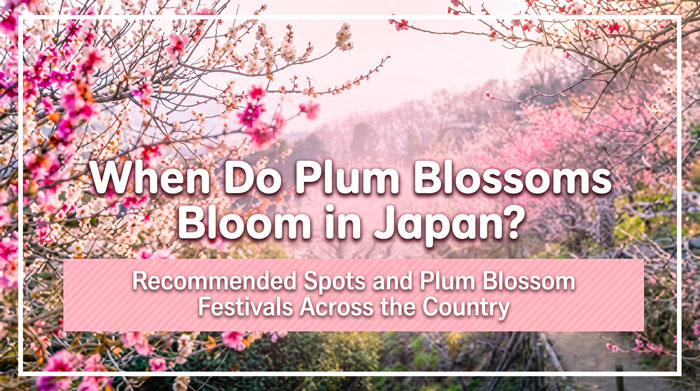
Plum blossoms are early-spring flowers that reach their peak from February to March in most regions of Japan. Because plum trees bloom earlier than cherry trees, even travelers who visit Japan before cherry blossom season can enjoy Japanese flower viewing with plum blossoms. At gardens and shrines where white and deep-pink blossoms bloom, the sweet fragrance of plum is another pleasure of the trip.
In this article, we’ll compare plum and cherry blossoms, explain when plum blossoms are at their best, and introduce recommended spots across Japan, plum blossom festivals, and photography tips. We hope it helps you find destinations that fit your travel dates as you plan your trip in February or March.
1. Basic Facts About Plum Blossoms in Japan

Source:X「@wni_jp」
Plum trees were introduced to Japan from China, and because they bloom early in the year, their blossoms have long been cherished as a sign that spring has arrived. In this section, we’ll look at the differences between plum and cherry blossoms and when plum blossoms are at their best.
1-1. Differences Between Plum and Cherry Blossoms
You can tell plum and cherry blossoms apart by four features: how the flowers grow on the branches, the shape of the petals, their fragrance, and when they bloom. Plum and cherry trees both belong to the rose family, and the single-flowered varieties of both have five petals. When you see the flowers in person, compare the four points in the table below.
| Plum Blossoms | Cherry Blossoms | |
|---|---|---|
| How the flowers grow | Flowers grow almost directly on the branch, with about one or two blossoms at each node | Flowers grow at the tips of stalks, and many varieties bloom in clusters |
| Petal shape | Rounded tips | Notched tips |
| Fragrance | A sweet, strong fragrance | Varieties such as Somei Yoshino have almost no fragrance |
| Blooming season | February to March in most regions | Late March to early May |
If you’re not sure, bring your face close to the flowers and check their scent to tell them apart more easily.
1-2. Peak Season from February to March
In most regions of Japan, plum blossoms are at their best from February to March. The blooming season of plum trees varies by region, altitude, and variety. As a rough guide, the peak season is from mid-February to early March in northern Kyushu and from mid-February to mid-March in the southern Kanto region.
Because the timing of plum blossoms depends on that year’s winter temperatures, be sure to check the bloom updates for each spot before your trip. Even in the same place, blooming times can differ by more than a month depending on the variety.
2. Recommended Plum Blossom Spots in Japan

Source:X「@kanko_ibaraki」
Famous plum blossom spots can be found throughout Japan, each offering its own distinctive scenery. Tenmangu shrines, which enshrine Sugawara no Michizane, known as the god of learning, are also famous places to enjoy the plum trees associated with him. Here are four recommended spots in Ibaraki, Kyoto, Osaka, and Fukuoka prefectures.
2-1. Kairakuen (Ibaraki)

Source:X「@kairakuen_ibrk」
Kairakuen is a garden in Mito, Ibaraki Prefecture, where about 3,000 plum trees of around 100 varieties bloom. Created in 1842 by Tokugawa Nariaki, lord of the Mito Domain, Kairakuen is counted as one of the Three Great Gardens of Japan, along with Kenrokuen in Kanazawa and Korakuen in Okayama. The name “Kairakuen” reflects Nariaki’s wish to create a place he could enjoy together with the people of his domain.
White, pink, and red plum blossoms bloom in the garden, and the bamboo grove, the cedar forest, and Kobuntei, a traditional building, are also worth seeing. In 2024, the group of plum varieties grown at Kairakuen and other sites was certified as a National Collection under the name “Mito no Ume” (Mito Plums). The Mito Plum Festival is held every year from mid-February to late March.
From Tokyo Station, the Limited Express Hitachi or Tokiwa on the JR Joban Line takes about 70 to 80 minutes to Mito Station. From the North Exit of Mito Station, take a bus bound for Kairakuen, and you’ll reach the nearest bus stop in about 15 to 20 minutes.
2-2. Kitano Tenmangu Shrine (Kyoto)

Source:X「@kitano_bunka」
Kitano Tenmangu is a shrine in Kyoto where about 1,500 plum trees of around 50 varieties, associated with Sugawara no Michizane, bloom. The waka poem that Michizane composed when he left the capital is addressed to plum blossoms. During the blooming season, red and white plum blossoms bloom throughout the shrine’s spacious grounds. Another appeal is the long viewing season: early-blooming plum trees start flowering just after the New Year, and the blossoms can be enjoyed until around the end of March.
The shrine’s plum garden, Hana no Niwa (Garden of Flowers), is usually open to the public from early February to late March. In 2026, it served as a venue for the art event “KYOTO NIPPON FESTIVAL” and was open from February 1 to May 24 (closed on some days). Every year on February 25, the Baikasai (Plum Blossom Festival) is held, along with a grand outdoor tea ceremony (nodate) where visitors can enjoy matcha in the open air.
Admission fees and opening periods vary from year to year, so be sure to check the latest information on the official website before your visit. Kitano Tenmangu is about a 5-minute walk from Kitano-Hakubaicho Station on the Keifuku Electric Railroad (Randen).
2-3. Osaka Castle Park (Osaka)

Source:X「@osakacastle_PR」
About 1,245 plum trees of 105 varieties bloom in the Plum Grove at Osaka Castle Park. The Plum Grove is located on the east side of Osaka Castle’s inner moat, where you can enjoy the blossoms with the castle’s main tower in the background. In the Plum Grove, which covers about 1.7 hectares, you can admire many different varieties of plum as you stroll.
In Osaka Castle Park, the plum blossoms are usually at their best from mid-February to early March, and the same park also has a peach orchard where about 200 peach trees of 12 varieties bloom. In April, about 3,000 cherry trees, mainly Somei Yoshino, also bloom here, so you can enjoy comparing plum and cherry blossoms by visiting in different seasons.
To reach the Plum Grove, walk through the park from Osakajokoen Station on the JR Osaka Loop Line.
2-4. Dazaifu Tenmangu Shrine (Fukuoka)
About 6,000 plum trees of around 200 varieties grow on the grounds of Dazaifu Tenmangu. Dazaifu Tenmangu is a shrine dedicated to Sugawara no Michizane and is busy all year round with worshippers praying for success in entrance exams and their studies. The sacred Tobiume (Flying Plum) tree is said to have flown from the capital in a single night to follow Michizane after he moved to Dazaifu. Every year, the Tobiume is the first of the plum trees on the shrine grounds to start blooming. In 2026, the plum viewing period ran from January 20 to March 15, and the plum blossoms are usually at their best from February to early March.
The approach to the shrine is lined with shops grilling umegae mochi, a Dazaifu specialty. Although the name umegae mochi includes the word “ume” (plum), it is generally made from rice flour, red beans, sugar, and salt, and contains no plums. Freshly grilled mochi are filled with chunky sweet red bean paste. Dazaifu Tenmangu is about a 5-minute walk from Nishitetsu Dazaifu Station.
3. Japanese Festivals Where You Can Enjoy Plum Blossoms

Source:X「@city_setagaya」
Plum blossom festivals are held across Japan from February to March to coincide with the peak bloom. Besides the blossoms, festival venues offer stage performances such as taiko drumming and sales of local specialties. Here are three festivals that are easy to visit on a day trip from Tokyo.
3-1. Bunkyo Plum Blossom Festival (Tokyo)

Source:X「@UENO_Info」
The Bunkyo Plum Blossom Festival is held every year from early February to early March at Yushima Tenmangu Shrine in Bunkyo City, Tokyo. On the shrine grounds, where about 300 plum trees, mainly white plums, bloom, stage performances such as taiko drumming are held during the festival, mostly on Saturdays, Sundays, and national holidays. On Sundays during the festival, there is also nodate, an outdoor tea ceremony where you can enjoy tea in the open air.
The venue is a 2-minute walk from Exit 3 of Yushima Station on the Tokyo Metro Chiyoda Line, making it an easy stop from central Tokyo.
3-2. Odawara Plum Blossom Festival (Kanagawa)
The Odawara Plum Blossom Festival is held every year from early February to early March at two venues: Soga Plum Grove and Odawara Castle Park. Soga Plum Grove has about 35,000 plum trees, and you can view Mt. Fuji and the plum blossoms together. Odawara Castle Park has about 250 plum trees, and the view of the blossoms with the castle’s main tower and other buildings in the background is one of its charms.
It takes about 35 minutes from Tokyo Station to Odawara Station on the Tokaido Shinkansen, and Soga Plum Grove is about a 20-minute walk from Shimo-Soga Station on the JR Gotemba Line.
3-3. Atami Baien Plum Blossom Festival (Shizuoka)

Source:X「@ataminews」
Atami Baien is known as the place to see Japan’s earliest-blooming plum blossoms, and its grounds are home to 469 plum trees of 60 varieties. The history of Atami Baien dates back to 1886, more than 100 years ago. Early-blooming plum trees usually start flowering around January, and depending on the variety, the blossoms can be enjoyed until around March. In 2026, the plum festival was held from January 10 to March 8.
During the plum festival, you can take a break at the footbath in the garden, a way to relax that’s unique to the hot spring town of Atami. It takes about 40 to 50 minutes from Tokyo Station to Atami Station on the Tokaido Shinkansen, and Atami Baien is about a 10-minute walk from Kinomiya Station on the JR Ito Line.
4. Tips for Photographing Plum Blossoms

Source:X「@ParksJindai」
Because plum blossoms are small and there tends to be space between the branches, the branches can sometimes stand out more than the flowers, depending on how you take the photo. Here are three photography tips that are easy to try, even with a smartphone.
・Get close to the flowers
Move close to the flowers within the range where your smartphone can focus, and tap a flower on the screen to focus on it. Choosing a flower that’s some distance from the background makes it easier to blur the background.
・Choose your background
We recommend including shrine buildings or blue sky in the background.
・Decide on your composition
Display a grid on your screen and place your main flower near where the lines intersect to create a well-balanced composition more easily.
To show how vast a plum garden is, we recommend holding your smartphone horizontally; to show how the branches stretch out, hold it vertically. At shrines and gardens, follow the rules on tripod use and restricted areas, and please do not touch the flowers or branches.
Conclusion
In most regions of Japan, plum blossoms are at their best from February to March. You can tell plum and cherry blossoms apart by how the flowers grow on the branches, the shape of their petals, and their fragrance. At famous plum blossom spots across Japan, you can enjoy the flowers along with the scenery of historic shrines and gardens, and at plum blossom festivals, you can also enjoy traditional events and local foods.
When taking photos, getting close to the flowers to focus and paying attention to the background and composition will help bring out the beauty of plum blossoms. Since blooming times vary by region and weather, check the latest bloom updates and enjoy plum blossom viewing in Japan in early spring.
*This article is based on information as of October 2026.