








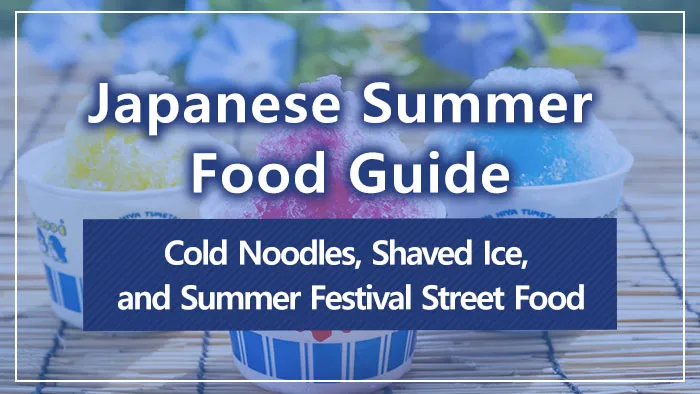
Japan has developed a wide range of foods designed to help people cope with the summer heat. Chilled somen and zaru soba noodles, kakigori (shaved ice topped with flavored syrup), and the takoyaki and yakisoba sold at summer festival stalls are all classic examples. This article divides Japanese summer food into four categories—cold noodles, seasonal staples, sweets and fruit, and festival street food—and introduces the character of each along with where to eat or buy it. By the end, you will be able to match what you eat to each day of your travel itinerary.

1. What Defines Japanese Summer Food

Summer in Japan brings both high temperatures and high humidity. From July through August, highs above 30°C (86°F) can continue for days on end. Because many people lose their appetite in the heat, summer tables fill up with cold, easy-to-eat dishes. Thin somen noodles, hiyashi chuka (chilled noodles served with a tangy sauce), and kakigori—shaved ice drizzled with syrup—are typical examples.
At the same time, foods such as unagi (freshwater eel) and edamame are long-standing summer favorites. Summer is also a season of abundant fruit and vegetables. Watermelon and peaches come into season from June through August, while cucumbers and tomatoes can simply be chilled and eaten as they are. Add to this the summer festivals held across the country in July and August, where stalls selling takoyaki and yakisoba line both sides of the street. The food sold at these festival stalls offers flavors unique to summer in Japan.
2. Cold Japanese Noodle Dishes to Try in Summer

Here we introduce three signature cold noodle dishes to try in summer: somen, zaru soba, and hiyashi chuka.
Somen is a wheat-flour noodle, thinner than udon. After boiling, the noodles are rinsed in cold water to firm them up, then dipped in mentsuyu, a soy-based dipping broth. The noodles slip smoothly down the throat. Chopped green onion, grated ginger, and myoga (Japanese ginger) are the standard accompaniments.
Besides specialty restaurants, somen can be found at udon shops and Japanese restaurants that add it to the menu for the summer only. Supermarkets and convenience stores sell dried somen and bottled mentsuyu, so you can easily prepare it in the kitchen of your accommodation. Miwa in Nara Prefecture, Banshu in Hyogo Prefecture, and Shodoshima in Kagawa Prefecture are all famous somen-producing regions.
Zaru soba consists of buckwheat noodles rinsed in cold water and served on a bamboo draining basket (zaru) or a slatted box (seiro). The noodles are topped with shredded nori seaweed and dipped a little at a time into the soba tsuyu. Rather than submerging the whole mouthful, dip only the first third or so of the noodles to appreciate the natural aroma of the buckwheat. After the meal, you may be served soba-yu, the hot water in which the noodles were boiled. Mix it with your leftover dipping sauce and enjoy it as a warm drink.
In addition to dedicated soba restaurants, you can order it at stand-and-eat soba counters inside train stations. If your travels take you to a soba-producing area such as Nagano or Shimane Prefecture, seek out a local shop.
Hiyashi chuka is a dish of chilled Chinese-style noodles topped with an attractive arrangement of shredded thin omelet, cucumber, ham, and tomato. It is dressed with either a vinegar-and-soy-sauce dressing or a sesame dressing, and eaten by tossing the toppings together with the noodles. Even on days when the heat has dulled your appetite, the tangy sauce makes this dish easy to enjoy. As summer approaches, you will often see signs in the doorways of ramen shops and Chinese restaurants reading “Hiyashi chuka hajimemashita”—”Hiyashi chuka is now being served.”
3. Traditional Dishes That Define Summer in Japan

Three traditional dishes that define summer in Japan are unagi, edamame, and hiyayakko.
Unagi, or freshwater eel, is the seafood most closely associated with Japanese summer. Kabayaki is the preparation in which butterflied fillets are skewered and grilled while being basted repeatedly with a sweet-savory sauce. Served over rice, kabayaki becomes unaju (in a lacquered box) or unadon (in a bowl). Japan has a custom of eating eel on Doyo no Ushi no Hi, the Midsummer Day of the Ox. Falling each year between mid-July and early August, it has long been observed as a day for restoring a body worn down by the heat.
Unagi is also known as a highly nutritious food, rich in vitamin A and B vitamins. You can of course eat it at specialty restaurants, but for a more casual option, packaged kabayaki is sold in the prepared-food sections of supermarkets and in the basement food halls of department stores.
Edamame are soybeans harvested while still young and green. The pods are boiled in salted water, and the beans are squeezed straight from the pod into the mouth. The saltiness and subtle sweetness pair perfectly with cold beer, making edamame the standard first order at any izakaya.
In summer, beer gardens—rooftop and open-air venues serving beer and food—open across Japan, and edamame is a common fixture on their menus. Fresh edamame appears in the produce section of supermarkets, and frozen edamame is available year-round. Since all it requires is boiling, it is easy to make even in accommodations with a minimally equipped kitchen.
Hiyayakko is chilled tofu served with soy sauce poured over it. The classic presentation tops the tofu with chopped green onion, grated ginger, and katsuobushi (dried bonito flakes). Because no cooking is involved, it keeps time in the kitchen to a minimum even on the hottest days.
Tofu is made from soybeans and is a good source of protein. Its light flavor and smooth texture bring a sense of coolness to the summer table. Hiyayakko appears on the menus of izakaya and casual set-meal restaurants, and if you pick up tofu and toppings at a supermarket or convenience store, you can put it together in moments at your accommodation.
4. Summer Sweets and Fruit in Japan

Four summer sweets and fruits worth trying in Japan are kakigori, watermelon, mizu-yokan, and mizu-manju.
Kakigori is a cold dessert of finely shaved ice topped with sweet syrup. The syrup flavors vary from shop to shop and include strawberry, melon, lemon, and matcha. More and more shops also offer add-ons such as condensed milk, sweet red bean paste, and shiratama rice-flour dumplings. The texture of the ice ranges from firm to feather-light depending on the establishment. At festival stalls and poolside kiosks, look for the flag bearing the character for “ice” (氷).
Watermelon is the quintessential fruit of summer in Japan. High in water and natural sugars, it is well suited to rehydrating after you have been sweating. A popular way to eat it here is to sprinkle a little salt on the cut slices—the saltiness brings out the sweetness. Supermarkets and fruit shops sell both whole watermelons and pre-cut portions in manageable sizes. At the beach, suikawari—in which a blindfolded person tries to split a watermelon with a stick—is a classic summer game.
Mizu-yokan is a traditional Japanese confection made from sweet red bean paste and agar. It contains more water than regular yokan, giving it a soft texture that melts on the tongue. It is typically chilled in the refrigerator, then cut into small pieces to serve. Traditional confectionery shops stock it only during the summer, and supermarkets carry canned and cup-packed versions. Its cool appearance also makes it a popular summer gift.
Mizu-manju is a confection in which sweet bean paste is wrapped in a translucent dough made from kudzu or bracken starch. It is best known as a specialty of Ogaki City in Gifu Prefecture, where some shops display it chilling in cold water. The sight of the bean paste seemingly floating inside the clear casing is a pleasure in itself. In supermarkets, you will usually find it in the Japanese confectionery corner near the bread section.
5. Street Food at Japanese Summer Festivals

At summer festivals and fireworks displays, food stalls line the streets leading to the venue. Stall food is served in paper trays or cups so that you can eat while you walk. Many stalls accept cash only, so it is wise to carry small change. Here we introduce takoyaki, yakisoba, and chocolate bananas.
Takoyaki is made by pouring a wheat-flour batter into a cast-iron pan with round molds, adding pieces of octopus, pickled red ginger, and green onion, and cooking the batter into balls. Born in Osaka, it is now a festival favorite nationwide. The finished takoyaki is topped with sauce and mayonnaise, then sprinkled with aonori (dried green seaweed flakes) and katsuobushi. The centers are very hot, so let them cool slightly before taking a bite.
Yakisoba is made by stir-frying Chinese-style noodles with pork and cabbage on a hot iron griddle and seasoning them with a savory sauce. At the stalls, you can watch the cook tossing the noodles across a huge griddle. Pickled red ginger and aonori are the customary finishing touches. The savory aroma of the sauce hitting the griddle drifts across the entire festival grounds.
Chocolate bananas are a festival staple: a banana on a stick coated in melted chocolate. Versions decorated with colorful sprinkles are especially popular with children. Served chilled, they are an easy dessert to enjoy even on a hot night.
Conclusion
The foods of a Japanese summer reflect both the ingenuity used to stay comfortable in the heat and the culture of celebrating at summer festivals. Somen and hiyashi chuka are cold noodle dishes that go down easily even when your appetite is flagging. Unagi and edamame are seasonal staples on the summer table. Kakigori, mizu-yokan, and watermelon take the edge off the heat with their coldness and sweetness.
The takoyaki, yakisoba, and chocolate bananas sold at festival stalls are pleasures you can enjoy on the move. If a summer festival falls during your trip, be sure to sample the stall food. Supermarkets and convenience stores also stock seasonal products, so you can enjoy the flavors of a Japanese summer right where you are staying.
*This article is based on information current as of July 2026.