









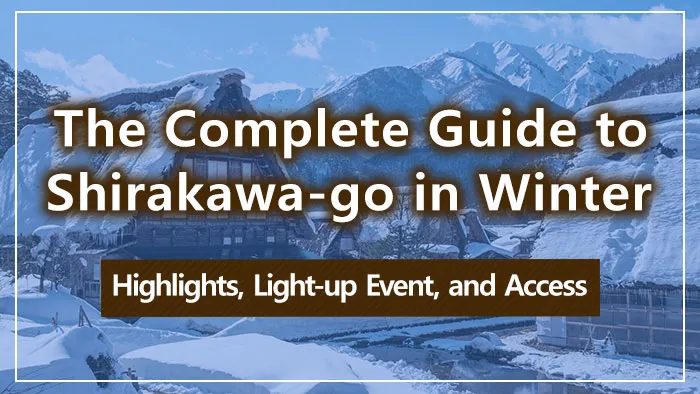
The keys to enjoying Shirakawa-go in winter are booking the light-up event in advance and preparing properly for the snow. Blanketed in white, this village of gassho-zukuri farmhouses is one of Japan’s most iconic winter landscapes, drawing travelers from around the world. This article explains what to see in Shirakawa-go in winter, the light-up event dates, how to reserve parking or choose a bus tour, how to get there from Takayama and Kanazawa, and what to wear on snowy roads.

1. What is Shirakawa-go in winter? A UNESCO World Heritage site where you can see gassho-zukuri houses under snow
Shirakawa-go is a village of gassho-zukuri farmhouses located in Shirakawa Village, Ono District, Gifu Prefecture, and it is inscribed on the UNESCO World Cultural Heritage List. It was inscribed in 1995 together with Gokayama in Toyama Prefecture as the “Historic Villages of Shirakawa-go and Gokayama.” Gassho-zukuri is a uniquely Japanese architectural style in which wooden beams are joined together to form a steep triangular frame. The name, which literally means “constructed like hands in prayer,” comes from the fact that the shape resembles two palms pressed together. The steeply pitched thatched roofs are an innovation devised by earlier generations to shed heavy snow.
Shirakawa Village is one of the snowiest places in Japan, and in some years the snow cover exceeds 170 centimeters in February. In winter, when snow blankets the entire village, the powerful forms of the gassho-zukuri houses set against the white landscape give Shirakawa-go its most beautiful face of the year.
2. Highlights and things to do in Shirakawa-go in winter
Shirakawa-go in winter can be enjoyed from two perspectives: walking among the houses and looking down on the village from above. Even though you are seeing the same gassho-zukuri houses, the impression made by the weight of the snow up close differs from that of the village spread out below you in a single sweeping view. This section covers the sights worth visiting in winter, divided into a walk through Ogimachi Village and the view from Shiroyama Viewpoint.
2-1. Stroll through the snow-covered gassho-zukuri houses of Ogimachi Village
Ogimachi Village forms the heart of Shirakawa-go, where roughly 100 gassho-zukuri houses of various sizes still stand and are lived in today. The village is small enough to cover on foot, and you should allow about two to three hours to look around. Houses buried in snow, snow-covered fields, and icicles hanging from the eaves can all be seen from just a few meters away.
Ogimachi Village follows three principles — “don’t sell, don’t rent, don’t demolish” — and has long avoided renovations that would spoil the traditional appearance of its buildings. Thanks to these principles, visitors can walk through a rural landscape that has changed little over the years.
2-2. Take in the panoramic view of snow-dusted Shirakawa-go from Shiroyama Viewpoint
From Shiroyama Viewpoint (the Ogimachi Castle Ruins Observation Deck), you can take in the snow-dusted gassho-zukuri houses and the mountain range behind them all at once.Managed by Shirakawa Village, this lookout offers the view of the village from above that is familiar from tourism posters.
The viewpoint is a 15- to 20-minute walk up the trail behind the Wada House, a historic residence open to the public.In winter, however, the trail becomes extremely slippery with snow and ice, so wear shoes with non-slip soles and check the day’s trail conditions with the Shirakawa-go Tourist Association before setting out. During the light-up event, only those holding an observation deck ticket may go up.
3. The light-up event held in Shirakawa-go in winter
The Shirakawa-go Light-up is a special event held on only a handful of days in midwinter. Advance reservations are mandatory, and the process is completely different from that for a daytime visit. This section covers four things to check so you can enjoy the event: dates, reservations, parking, and bus tours.
3-1. Check the dates and times of the light-up event
The 41st Shirakawa-go Light-up Event, in 2027, will be held on four days: January 11 (Mon., national holiday), January 17 (Sun.), January 24 (Sun.), and January 31 (Sun.). On all four days the lights are on from 5:30 p.m. to 7:30 p.m., and the venue is the Ogimachi district of Shirakawa Village. The dates change every year, so check the Shirakawa-go Tourist Association’s announcements before your trip.
Since the event runs on only four days, decide which light-up date you want first, then plan the rest of your trip around it. If a widespread cold wave causes major traffic disruptions, the organizing committee may cancel the event.
3-2. Make the reservation required to attend the light-up
The light-up event is entirely reservation-based, and visitors without a booking cannot attend. Participants receive an admission ticket and wear it around their necks while walking through the village. No same-day tickets are sold.
Visitors choose one of the following five options:
- Stay overnight in Shirakawa Village (includes an observation deck ticket)
- Come by private car and reserve a designated parking space
- Come by taxi and reserve a designated parking space
- Join a bus tour operated by a bus company
- Join a bus tour operated by a travel agency
Accommodation in the village is allocated by lottery rather than on a first-come, first-served basis, with applications accepted from October 1 to 31, 2026.From 3:30 p.m. on event days, a gate is set up at the entrance to the village, and anyone without an admission ticket cannot enter.
3-3. Reserve a parking space in advance if you’re coming by car
If you’re driving to the light-up event, be sure to reserve a space at the Midashima Parking Lot. Only standard passenger cars can be booked; buses and campervans cannot park there.
Parking reservations for 2027 are released in two rounds, and the first round, released on September 10, 2026, has already sold out. The second round goes on sale on the Shirakawa-go Tourist Association website at 1:00 p.m. on December 1, 2026, priced at 7,000 yen per vehicle for one to five people and 10,000 yen for six to ten people. Reservations cannot be cancelled or resold.
The parking lot opens at 3:00 p.m., and all vehicles must leave by 8:00 p.m. If you’re driving to Shirakawa-go in winter, studless snow tires are essential.
3-4. Take a bus tour departing from Takayama, Kanazawa, or elsewhere
If you don’t drive, take one of the reservation-only bus tours departing from Takayama or Kanazawa. There are no scheduled buses back to central Takayama after the light-up, so tour buses are the main way to travel at night. Five companies operate these tours: Nohi Bus, Kaetsunou Bus, Toyama Chitetsu Bus, Hokutetsu Bus, and Iruka Kotsu.
Whether an observation deck ticket is included varies by tour, so check the departure point, the itinerary, and the services included before booking.
| Departure point / Operator | Fare (adult) | Observation deck ticket |
|---|---|---|
| Takayama / Nohi Bus, Course A | 13,000 yen | Not included |
| Takayama / Nohi Bus, Course B | 16,000 yen | Included |
| Kanazawa / Hokutetsu Bus | 18,500 yen | Included |
Bus tour reservations open on different dates for each event day; bookings for the January 11, 2027 departures open at 2:00 p.m. on October 13, 2026.
4. Points to check before visiting Shirakawa-go in winter
To enjoy Shirakawa-go in winter safely, sort out how you’ll get there and how you’ll stay warm before you leave. There is no train station near Shirakawa-go, and midwinter temperatures drop below freezing. This section covers two things to check before your trip: access and clothing.
4-1. Getting there by highway bus from Takayama or Kanazawa
Because there is no train station near Shirakawa-go, highway buses from Takayama or Kanazawa are the standard way to get there. The highway bus takes about 50 minutes from Takayama Station to the Shirakawa-go Bus Terminal, and about 1 hour and 20 minutes from Kanazawa Station. Both journeys are short enough to make a day trip from Takayama or Kanazawa easy to arrange. From Nagoya, the highway bus from the Meitetsu Bus Center takes about 2 hours and 30 minutes.
In winter, buses may be delayed by snowfall and icy roads.Check the service status before departure, and book highway bus seats early during busy periods such as the New Year holidays and long weekends.
4-2. Preparing clothing and footwear for snow and cold
Temperatures in Shirakawa-go drop below freezing in winter, so dress for midwinter conditions. According to Japan Meteorological Agency climate normals, the average January temperature in Shirakawa is -1.0°C, with an average daily minimum of -4.4°C. In February, the average daily minimum falls to -5.0°C.
For your upper body, wear warm base layers and a fleece, then add a waterproof down jacket on top. Your head and hands also lose heat, so bring a knit hat and gloves as well.
For footwear, choose waterproof snow boots with deep treads.Temperatures drop sharply after late afternoon and some areas ice over, so non-slip shoes suited to snowy ground are essential.
Conclusion
In winter, Shirakawa-go lets you walk through the snow-covered Ogimachi Village and take in the whole settlement from Shiroyama Viewpoint. The light-up event, held on just four days in January, is entirely reservation-based, so be sure to secure one of the options in advance: an overnight stay, a parking reservation, or a bus tour. With highway buses taking about 50 minutes from Takayama and about 1 hour and 20 minutes from Kanazawa, a day trip is also possible. Prepare for sub-zero temperatures and snowy roads with warm clothing and non-slip footwear.
*This article is based on information available as of September 2026.