








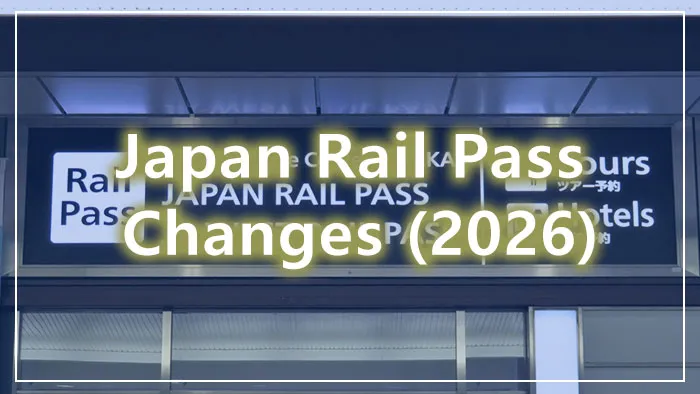
The Japan Rail Pass is a pass issued for foreign tourists visiting Japan that allows unlimited travel on the Shinkansen and all JR lines nationwide. It is known as a convenient way for travelers who want to move efficiently across a wide area to explore various parts of Japan while keeping costs down. Some changes have been made for 2026, so if you are planning based on previous information, it is important to check the latest details.
In this article, we organize the 2026 changes by category and also explain how to choose a pass and address common questions. We hope this serves as a useful reference for anyone considering traveling to Japan.

1. What Are the Japan Rail Pass Changes (2026)?
Alongside the price revision for Japan Rail Pass purchases made from October 1, 2026 onward, it is important to review and confirm the updated eligibility conditions, pricing, coverage, purchasing methods, and exchange methods. Below, we explain the main changes in order.
1-1. Eligibility Conditions
The eligibility conditions for the Japan Rail Pass will not change significantly under the revision applying to purchases from October 1, 2026. The primary eligible users are foreign travelers visiting Japan for tourism purposes under a “Temporary Visitor” visa status, as well as Japanese nationals residing overseas who meet the applicable conditions. Foreign travelers must have a “Temporary Visitor” stamp or sticker in their passport, and it must remain verifiable even when an automated gate has been used at immigration.
Japanese nationals residing overseas are required to present specified supporting documents demonstrating continuous residence outside Japan for 10 or more years, such as a copy of their Overseas Residency Registration, a Certificate of Overseas Residence, or a Permanent Resident Card. Please note that even if a pass has already been purchased, it cannot be exchanged if the holder does not meet the eligibility requirements or if the required documents are incomplete.
1-2. Prices
Japan Rail Pass prices will be revised for purchases made from October 1, 2026 onward. The previous price revision was in October 2023, and this revision reflects fare adjustments by some JR companies.Please note that the prices on the dedicated website’s Web sales service will remain unchanged for the time being in order to encourage usage.
| Car Type | Validity Period | Category | Before Revision | After Revision |
|---|---|---|---|---|
| Ordinary Car | 7 days | Adult | ¥50,000 | ¥53,000 |
| Child | ¥25,000 | ¥27,000 | ||
| 14 days | Adult | ¥80,000 | ¥84,000 | |
| Child | ¥40,000 | ¥42,000 | ||
| 21 days | Adult | ¥100,000 | ¥105,000 | |
| Child | ¥50,000 | ¥53,000 | ||
| Green Car | 7 days | Adult | ¥70,000 | ¥74,000 |
| Child | ¥35,000 | ¥37,000 | ||
| 14 days | Adult | ¥110,000 | ¥116,000 | |
| Child | ¥55,000 | ¥58,000 | ||
| 21 days | Adult | ¥140,000 | ¥147,000 | |
| Child | ¥70,000 | ¥74,000 |
1-3. Coverage
There are no changes to coverage.The pass can be used on all JR lines nationwide, including the Shinkansen, limited express (Tokkyu), express (Kyuko), rapid (Kaisoku), local trains, and BRT (Bus Rapid Transit). It also covers the Tokyo Monorail, certain third-sector railways, select routes operated by JR Bus companies, and JR West Miyajima Ferry.
One of the pass’s key features is how easy it makes traveling across a wide area of the country. However, if you wish to travel on the “Nozomi” or “Mizuho” services on the Tokaido/Sanyo/Kyushu Shinkansen, you must purchase a separate dedicated surcharge ticket before boarding. An additional fee also applies when using Gran Class on the Tohoku/Hokkaido/Joetsu/Hokuriku Shinkansen.
1-4. How to Purchase
There are no changes to the purchasing method.Travelers who meet the eligibility conditions may enter Japan on a Temporary Visitor visa, confirm their eligibility, and then purchase the pass through the dedicated website “JAPAN RAIL PASS Reservation.” When purchasing, you will need to enter the traveler’s name, passport number, and email address. Payment is accepted only by credit card in the purchaser’s own name. Passes can be arranged for up to 6 people including the purchaser, and those who purchase through the official website can also reserve seats on the Shinkansen or limited express trains before arriving in Japan. The pass is collected and used after arriving in Japan.
1-5. How to Exchange (Counter / Reserved Seat Ticket Machines)
There are no changes to the exchange method. After arriving in Japan, prepare your Web purchase receipt number and your passport showing proof of “Temporary Visitor” status, then collect your Japan Rail Pass at a designated exchange counter. If collecting passes for travel companions, all members of the party must present their passports. In addition, from April 1, 2026, passes purchased via Web reservation can also be exchanged at select reserved seat ticket machines equipped with passport readers in the JR East and JR West service areas. Exchange vouchers purchased through travel agencies and similar outlets continue to be exchanged at designated counters only.
2. Japan Rail Pass Validity Periods and How to Choose
全線開業記念日おめでとう、東北新幹線
— TRAIN TRIP【JRグループ公式】 (@JRgroup_cp) December 4, 2025
(っ'-')╮ =͟͟͞͞🎂ブォン 🚅#2010年全線開業#いつのまにか15周年
#TRAINTRIPpic.twitter.com/5nCJ9Tp1Tu
The Japan Rail Pass is available in three validity options — 7 days, 14 days, and 21 days — and it is important to choose based on the length of your trip and the distances you plan to travel. Here we introduce the features of each validity period and guidance on how to choose.
2-1. 7-Day Pass
The 7-day pass is well-suited for those who want to travel around Tokyo, Kyoto, and Osaka over the course of one week. For a first-time visit to Japan, a practical itinerary would be to travel from Tokyo to Kyoto and Osaka, adding Hiroshima or Kanazawa if time allows. The more intercity travel your itinerary involves, the more value you will get out of the pass — that said, packing in too many legs will eat into sightseeing time, so limiting your destinations to around 2 to 4 cities keeps things manageable. This pass is a good fit for trips that venture from Tokyo to the Kansai region and further out to regional cities, covering a wide area efficiently even within a short period.
2-2. 14-Day Pass
The 14-day pass is ideal for those who want to spend two weeks exploring Japan at a more relaxed pace, incorporating regional cities and day trips alongside the major urban centers. For example, a straightforward itinerary would be to arrive in Tokyo, then visit Kanazawa, Kyoto, Osaka, Hiroshima, and Fukuoka, before returning to Tokyo at the end. The pass makes it easy to spend multiple nights in each destination as well as travel between cities, striking a good balance between transit and sightseeing. It is a great choice if you want to add regional cities to the classic Golden Route, or if you want to ensure you have enough time to enjoy each destination.
2-3. 21-Day Pass
The 21-day pass is suited for those who want to take their time traveling all around Japan, incorporating not only Tokyo, Kyoto, and Osaka, but also Hiroshima, Fukuoka, Kagoshima, Kanazawa, Sendai, and Sapporo. For example, a feasible itinerary would be to head west through Honshu, extend your journey to Kyushu, then make your way through Hokuriku and Tohoku before heading to Hokkaido. Even with extensive long-distance travel, the pass makes it easy to spend multiple nights in each area, allowing you to enjoy not just city sightseeing but also regional scenery and local food culture. This pass is ideal for longer stays where you want to visit multiple regional cities in addition to the major urban centers.
3. Frequently Asked Questions About Using the Japan Rail Pass
When using the Japan Rail Pass, there are a number of things to confirm in advance, such as routes that are not covered, how to reserve reserved seats, and how to pass through automatic ticket gates. Here we address frequently asked questions that are good to know before you travel.
3-1. Which Routes Are Not Covered by the Japan Rail Pass?
The main routes not covered by the Japan Rail Pass include railways other than JR — such as Tokyo Metro and private rail lines — as well as certain JR Bus routes including highway buses. In addition, the “Nozomi” and “Mizuho” services on the Tokaido/Sanyo/Kyushu Shinkansen cannot be used with the pass alone; a separate dedicated surcharge ticket must be purchased before boarding. Gran Class on the Tohoku/Hokkaido/Joetsu/Hokuriku Shinkansen, as well as sections that extend onto private rail lines, also require an additional fare. We recommend checking carefully in advance whether your intended routes are covered before you travel.
3-2. How Do I Reserve a Reserved Seat with the Japan Rail Pass?
If you purchased your Japan Rail Pass through the Web sales service, you can make advance reservations for reserved seats through the dedicated website. Reserved seat tickets you have booked can be collected at reserved seat ticket machines or at a Midori no Madoguchi (Green Window ticket office) at JR stations before boarding. You can also reserve and issue tickets at reserved seat ticket machines at stations using the QR code or identification number on your pass along with your passport number. There is no additional charge for reserving a reserved seat itself, but popular trains and trains during busy periods can sell out quickly, so it is advisable to arrange your reservations early.
3-3. Can the Japan Rail Pass Be Used at Automatic Ticket Gates?
The Japan Rail Pass can be used at the automatic ticket gates found at most JR stations. When passing through, insert your pass into the ticket slot and be sure to retrieve it from the exit slot after passing through. The basic procedure is the same whether you are traveling on the Shinkansen or on conventional lines. However, automatic gates marked “IC Only” cannot be used with the pass. Please also note that a reserved seat ticket or a “Nozomi/Mizuho Surcharge Ticket” alone is not sufficient to pass through the gate — a valid Japan Rail Pass must be used in conjunction.
Summary
While Japan Rail Pass prices will be revised for purchases made from October 1, 2026 onward, there are no significant changes to the basic framework of eligibility conditions, coverage, purchasing methods, or exchange methods. It is important to select the 7-day, 14-day, or 21-day pass according to the length of your trip, and to check in advance which routes are covered, how to reserve reserved seats, and how to use the automatic ticket gates.
To ensure smooth travel within Japan, you should also familiarize yourself with the conditions for using the “Nozomi” and “Mizuho” services, how to collect reserved seat tickets, and what documents you need to bring for the exchange, so that you can make the best use of the pass for your own itinerary.
※This article was created based on information available as of April 2026.