







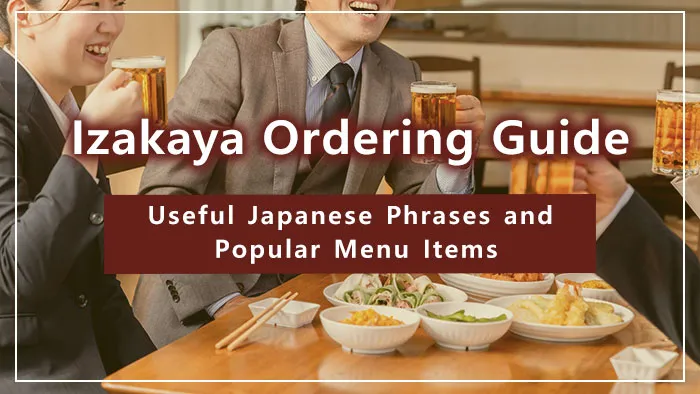
Japanese izakaya are a popular dining style where you can enjoy food and conversation at the same time. However, first-time visitors may feel confused by the ordering methods and unique customs. Language differences, in particular, can make smooth communication difficult.
This article introduces practical expressions you can use right away, following the flow from entering the restaurant to making payment. It also explains popular menu items, customs unique to izakaya, and the differences between ordering styles, so please use it as a reference if you want to experience Japanese izakaya culture.

1. Useful Japanese Phrases for Izakaya
やってきました、トリ金✨
— 鳥貴族 トリッキー (@_torikizoku) March 27, 2026
ジュ〜っと焼き上がるこの香ばしさ…
今夜は焼鳥と一杯で、
1週間の締めくくりしませんか?☺️
トリキでお待ちしてます🐥🍻 pic.twitter.com/JuMn4babfQ
At Japanese izakaya, using simple Japanese helps make ordering and conversation flow smoothly. There is no need to memorize difficult grammar—short phrases used correctly will get your message across. In particular, “Sumimasen” (Excuse me) and “Onegaishimasu” (Please) are basic expressions that come in handy in any situation.
Here, we introduce practical phrases that foreign travelers can use right away, following the flow from entering the restaurant to paying.
1-1. Entering the Restaurant
When you enter, first let the staff know how many people are in your party and whether you have a reservation. Staff will usually ask “Nanmei-sama desu ka” (How many people?), so you can simply answer “Futari desu” (Two people) or “Sannin desu” (Three people). If you have a reservation, give your name with “Yoyaku shiteimasu. ○○ desu” (I have a reservation under ○○). If you do not have a reservation, ask “Yoyaku shiteimasen ga, aiteimasu ka” (I don’t have a reservation—do you have any seats available?) for a smooth process. At Japanese restaurants, staff will guide you to your seat, so wait to be seated rather than choosing your own table.
1-2. Ordering
When ordering, first get a staff member’s attention. Saying “Sumimasen” (Excuse me) while raising your hand slightly is a natural way to be noticed. Then say “Chumon o onegaishimasu” (I’d like to order) or “Order ii desu ka” (Can I order?). For food and drinks, simple phrases like “Kore kudasai” (This one, please) or “Beer o onegaishimasu” (Beer, please) are enough.
If you want to know what’s recommended, ask “Osusume wa nan desu ka” (What do you recommend?) and the staff will tell you their popular menu items. To check whether an English menu is available, ask “Eigo no menu wa arimasu ka” (Do you have an English menu?).
For another round, say “Okawari o onegaishimasu” (Another, please), and for multiple orders, add a number, as in “Beer o futatsu onegaishimasu” (Two beers, please). The key to smooth ordering is to use simple expressions repeatedly.
1-3. Changes and Special Requests
If you want to change ingredients or have allergy concerns, communicate clearly. If you have allergies, check in advance with “○○ wa haitteimasu ka” (Does this contain ○○?). For example, asking “Tamago wa haitteimasu ka” (Does it contain eggs?) lets the staff confirm the ingredients so you can decide whether the dish is safe to eat.
If you want to leave out an ingredient, say “○○ nuki de onegaishimasu” (Without ○○, please). Short phrases like “Wasabi nuki” (No wasabi) or “Kori nuki” (No ice) get the message across. If you want a condiment served separately, you can request “Mayonnaise wa betsu de onegaishimasu” (Mayonnaise on the side, please).
At Japanese izakaya, individual requests are usually accommodated when possible, though it may be more difficult during busy times. Communicating politely will help ensure smoother service.
1-4. Payment
When you finish your meal, ask for the bill by saying “Okaikei o onegaishimasu” (Check, please). Some restaurants take payment at the table while others have you pay at the register, so check the receipt and act accordingly.
To confirm payment methods, ask “Card wa tsukaemasu ka” (Can I use a credit card?) or “QR kessai wa tsukaemasu ka” (Can I use QR code payment?). Some restaurants accept cash only, so it’s a good idea to check in advance. After paying, saying “Gochisousama deshita” (Thank you for the meal) shows appreciation for the food and service. Maintaining polite communication to the very end leaves a positive impression at the close of your meal.
2. Popular Menu Items at Izakaya
皆さまー📢
— 磯丸水産🐟🦐🐚【公式】 (@isomaru_suisan_) April 3, 2026
今日も元気に営業中‼#磯丸水産 です🐟
🌸も今日が見納めのような😂
花見の後は新しいメニューを販売した
磯丸水産へGO🍻#磯丸 おすすめの「#舟盛り」を
ご紹介🐟🦐🐚
まぐろをはじめ、鯛、海老、サーモンなどの
刺身と白子までのっかってる
豪華な🚢です✨
週末は #昼飲み… pic.twitter.com/lrccTwZnqy
Izakaya menus feature many simple, easy-to-eat dishes, so even first-timers can order with confidence.
A perennial favorite is “edamame” (boiled young soybeans). Since it’s served quickly, many people choose it as their first dish. Next, “yakitori” (grilled chicken skewers) lets you choose your seasoning—salt or sauce—so you can enjoy it to your taste. “Karaage” (Japanese-style fried chicken) is crispy on the outside and juicy on the inside, and is loved by many. In addition, “sashimi” (fresh sliced raw fish) and the mild-tasting “dashimaki tamago” (rolled omelet seasoned with dashi broth) are also popular menu items.
For drinks, there is a custom called “toriaezu beer” (meaning “beer to start with”), where ordering a beer as the first drink is a common practice. By choosing these popular menu items, you can easily experience a meal that captures the spirit of a Japanese izakaya.
3. Customs Unique to Izakaya
\今日から7月☀️/
— 【公式】塚田農場 (@tsukada_nojo_) July 1, 2024
早いもので2024年も下半期に突入です✨‼️
塚田農場では7月10日(水)から
新メニューがスタートします🍅🍆🐓
新メニュー発売に先立って
宮崎本店にて生産者さん向けの
試食会を開催しました✨✨
生産者さんが作ってくださっている
農作物や地鶏が、どのような形で… pic.twitter.com/hFOUU5mEgP
Japanese izakaya have unique customs that differ from those of restaurants overseas. Without prior knowledge, you may find some situations confusing, but understanding the basics in advance will put you at ease.
Here, we explain “otoshi” and the time-limit system, both of which are widely adopted at many establishments.
3-1. Otoshi
“Otoshi” is a small appetizer served automatically when you take your seat. It is provided even if you didn’t order it, and you pay for it as a kind of seating charge.The price varies by restaurant, but it is generally around 300 to 500 yen.
The contents are often a small seasonal dish or a simple snack, offering a casual taste of Japanese food culture. Since it can be difficult to decline at some restaurants, it’s best to think of it as part of your seating fee from the start. It also helps to remember that it is automatically added to the bill.
3-2. Time Limits
Many izakaya set a time limit, such as “2 hours,” especially on weekends and during busy times. This system allows them to seat more customers. The time limit is explained when you arrive or make a reservation, so it is important to confirm your start time.
There is also a “last order” before closing time. It is generally set 30 minutes before the end time, and that is when you place your final order. Asking “Last order wa nanji desu ka” (What time is last order?) will give you peace of mind. Since you cannot place additional orders after this time, ordering with some time to spare will help you enjoy a more comfortable experience.
4. Izakaya Ordering Systems and How to Choose a Plan
ポットモーニング🍲🔥
— 赤から【公式】 (@koraakakara) October 22, 2025
昨日の #むかいの喋り方 でお便り送ってくれた方感謝です☺️
牡蠣鍋のお知らせにてパンサー向井さんが歌う「赤からいこうぜ」使わせてもらってます!(吉本様に許可頂きました🙌)
こんな寒い日は…
赤からいこうぜ! pic.twitter.com/E88z4TBUEB
Japanese izakaya offer several ordering styles. Choosing the plan that best suits the restaurant and your purpose makes the meal more enjoyable.
Here, we introduce four representative ordering systems. Understand the features of each, and choose based on your group size, budget, and how long you plan to stay.
4-1. À la Carte (Individual Orders)
À la carte is a style where you freely order each dish you want, one at a time. It is the most common method at izakaya, allowing you to choose only the dishes you want to eat. It suits small groups and those who want to eat and drink lightly.
You can also order whenever you like, adding food and drinks as your meal progresses. Since the total cost grows only with what you order, it’s important to keep your budget in mind as you choose. For your first visit to an izakaya, à la carte is a flexible option that’s easy to manage.
4-2. All-You-Can-Drink
All-you-can-drink is a plan where you pay a flat rate and can order as many of the included drinks as you like within a set time. It generally has a time limit of 90 to 120 minutes. Beer, sour (a shochu-based highball-style cocktail), and soft drinks are commonly included.
This plan is well-suited to groups and to those who want to drink a lot. However, some drinks are not included, so check the contents before ordering. Many restaurants also use a glass-exchange system, asking customers to be mindful and avoid leaving drinks unfinished.
4-3. All-You-Can-Eat
All-you-can-eat is a plan that lets you order as much as you want from the menu for a flat fee. As long as you stay within the time limit, you can place orders multiple times. It is commonly offered at yakiniku (Japanese barbecue) restaurants and some izakaya.
This plan suits people who want to try many varieties or really enjoy a hearty meal. However, additional charges may apply for leftover food.It’s important to order amounts you can finish and to enjoy yourself within reasonable limits.
4-4. Food Course
A food course is a plan where the restaurant serves a selection of dishes in sequence. It is structured in a balanced way, from appetizers to a main course and a final dish. Since the price is set in advance, it is easy to manage your budget.
It is often combined with all-you-can-drink and is well-suited to groups and parties. Since the contents differ from restaurant to restaurant, checking the menu in advance is a good idea. Even on a first visit to an izakaya, choosing a course allows you to enjoy your meal smoothly.
Conclusion
To enjoy a Japanese izakaya, it is important to understand basic Japanese phrases and a few simple customs. Using expressions such as “Sumimasen” (Excuse me) and “Onegaishimasu” (Please) helps you order and converse smoothly.
Also, knowing in advance about unique systems like otoshi and time limits will reduce confusion. You don’t need extensive knowledge to visit a Japanese izakaya, but mastering the basics greatly improves the experience. Understand Japanese izakaya culture and enjoy your meal and conversation with confidence.
*This article is based on information available as of May 2026.