







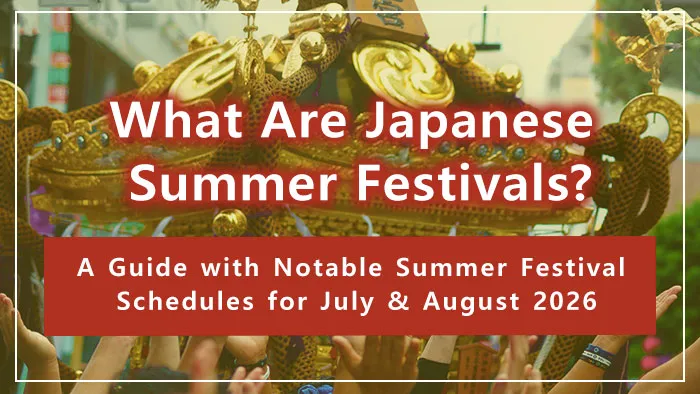
Japanese summer festivals are events where you can experience the lively energy of summer and the culture of local communities through food stalls, fireworks, dancing, and yukata (traditional summer kimono). Each festival has its own history and atmosphere — some feature processions of portable shrines (mikoshi) and decorative floats (dashi), while others center on fireworks or dancing. Simply strolling through the venue gives you a real sense of what makes each region special, making summer festivals a popular draw for travelers and tourists. In this article, we outline the key features of Japanese summer festivals and introduce five notable festivals taking place in July and August 2026.

1. What Are Japanese Summer Festivals?

Japanese summer festivals are communal events where local residents come together to enjoy food stalls, dancing, fireworks, and other quintessential sights and sounds of summer. To help you understand what makes them so lively and appealing, this section walks you through how to enjoy them, what to eat, and what to wear.
1-1. How to Enjoy Summer Festivals
The best way to enjoy a summer festival is to soak up the atmosphere while discovering what makes each local celebration unique. Depending on the festival, you might catch processions of mikoshi (portable shrines) or dashi (decorative floats), bon odori (traditional Obon circle dancing), or dazzling fireworks displays — all evocative of the Japanese summer spirit. Browsing the food stalls is a classic part of the experience, and carnival-style games like kingyo-sukui (goldfish scooping) and shateki (cork-gun shooting galleries) are beloved by visitors of all ages. Since each festival has its own highlights and schedule, it’s worth researching in advance so you can make the most of your visit.
Whether you go with friends and family or simply take your time watching the local dances and processions pass by, you’ll find yourself immersed in the distinctive character of the place. Wearing a yukata adds an even deeper sense of the season and makes it easy to create memories that feel distinctly Japanese.
1-2. Foods at Summer Festivals
When it comes to summer festival food, the yatai (outdoor food stalls) are the heart of it all, offering everything from savory dishes to sweet treats.Classic savory options include yakisoba (stir-fried noodles), takoyaki (octopus balls), okonomiyaki (savory pancakes), yakitori (grilled chicken skewers), and ika-yaki (grilled squid), their irresistible aromas adding to the festive mood. On the sweeter side, kakigori (shaved ice), taiyaki (fish-shaped pastries filled with sweet red bean paste), baby castella (bite-sized sponge cakes), ichigo ame (strawberry candy apples), and choco banana (chocolate-dipped bananas) are perennial favorites. With such a wide range — from full meals to snacks — grazing your way through the stalls as you walk is one of the great pleasures of a summer festival.
The food is easy to enjoy for all ages and is generally affordable, making it simple to sample a little of everything. Since the stalls and regional specialties vary from venue to venue, comparing what’s on offer at different festivals can be a fun adventure in itself.
1-3. Yukata: What to Wear at Summer Festivals
Yukata are lightweight, unlined summer garments in the kimono tradition, widely worn at summer festivals and fireworks events. Originally worn after bathing or for relaxing at home, they have become firmly established as the go-to festive dress for summer events in Japan. Typically made from breathable materials such as cotton or linen, they are relatively comfortable to wear even in the heat. With a wide variety of colors and patterns available, they suit people of all ages and are a great choice for anyone who wants to immerse themselves more fully in the festival atmosphere.
Wearing a yukata amid the glow of food stall lanterns and the energy of bon odori dancing heightens the sense of the season and brings you closer to the distinctive aesthetic charm of a Japanese summer. In recent years, alongside traditional patterns, more contemporary designs have also become popular, offering plenty of room to express your own personal style.
2. Five Japanese Summer Festivals in July & August 2026

Across Japan, July and August 2026 will see a wide array of summer festivals. Here we spotlight five of the most iconic, held in Kyoto, Osaka, Tokyo, Aomori, and Tokushima, and walk you through the highlights of each.
2-1. Kyoto · Gion Matsuri (July 1–31)
Gion Matsuri is a summer festival with over a thousand years of history, held in Kyoto throughout the entire month of July as a religious celebration of Yasaka Shrine. The festival’s centerpiece is the Yamahoko Junko — the grand procession of elaborately decorated floats and halberds known as yamahoko — with the Sakimatsuri procession on July 17 and the Atomatsuri procession on July 24. During Yoiyama (the festival evenings leading up to the processions), the sound of gion-bayashi (traditional festival music) fills the air as spectators can view the yamahoko up close, and the entire neighborhood comes alive with festive energy. During the processions, highlights include the dramatic辻廻し (tsuji-mawashi) — the skillful sharp-turning of the massive floats at street corners — and the intricately crafted decorative tapestries (kenshohin) adorning each float.
With a rich program of religious ceremonies and events stretching across the full month, Gion Matsuri is celebrated nationwide as the defining summer festival of Kyoto. The magnificent yamahoko are often described as “moving art galleries,” and their combination of historical gravitas and visual splendor is one of the festival’s greatest draws. From the Yoiyama evenings through to the processions, there is no shortage of things to see, making this one of the best ways to experience Kyoto’s living traditional culture.
2-2. Osaka · Tenjin Matsuri (July 24–25)
Tenjin Matsuri is one of Japan’s Three Great Festivals and one of Osaka’s most iconic summer celebrations, rooted in over a thousand years of history at Osaka Tenmangu Shrine. A full program of religious ceremonies takes place centered on the Yoimiya (evening festival) on July 24 and the Honmiya (main festival) on July 25, with the highlight being the Funatogyo — a procession of lantern-lit boats along the river — and a dedicated fireworks display on the night of the 25th.
The sight of countless boats gliding along the Okawa River, their lights reflected on the water while fireworks burst overhead, is a spectacle that captures the splendor of Osaka as a city of water (Suito Osaka). Ceremonies such as the Rikutogyo (land procession) and the Hoko-nagashi Shinji (ritual of floating a sacred halberd) add a layer of solemn historical tradition, while the festive energy all around is unmistakably Osaka.
The whole city is enveloped in the excitement of the festival, making even simply watching a special experience — and one well suited to anyone who wants to enjoy both history and spectacle. It draws enormous crowds year after year as the definitive summer festival of Osaka.
2-3. Tokyo · Sumida River Fireworks Festival (July 25)
✨テレビ放送中同時開催✨花火ミュージアム企画🎆
— (公式)隅田川花火大会 (@sumida_river_fw) July 25, 2020
現在放送中の【平成29年】で事務局が選んだベストショットはこの2枚!!
観る場所によって様々な表情を見せる隅田川の花火。
都会のビルや街中の建物の間から顔を覗かせる花火が特徴ですね!#みんなで隅田川花火大会#隅田川花火大会2020pic.twitter.com/zO4614NyHu
The Sumida River Fireworks Festival traces its origins to the Edo period tradition known as “Ryogoku no Kawabira” — the ceremonial “opening of the river” at Ryogoku — and is one of Tokyo’s most iconic summer events. Under its current name, the festival has been held since 1978; in 2026, it takes place on July 25. The event is split between two venues along the Sumidagawa River, with approximately 20,000 fireworks lighting up the summer night sky. At the first venue, a fireworks competition is held in which pyrotechnicians compete for top honors, adding another layer of excitement for connoisseurs.
Set against the atmospheric backdrop of Tokyo’s shitamachi (traditional downtown) neighborhoods, the festival blends time-honored tradition with a dazzling contemporary spectacle, making it a beloved symbol of the Tokyo summer. The riverfront views paired with the powerful launches create different vistas depending on where you watch, which is part of its enduring appeal. The surrounding streets fill with visitors in yukata, and the celebratory mood makes this one of the most evocative summer festival experiences in the city.
2-4. Aomori · Nebuta Matsuri (August 2–7)
Aomori Nebuta Matsuri is one of the Tohoku Three Great Festivals, held annually from August 2 to 7 in Aomori City. The festival’s defining image is that of enormous, brilliantly illuminated papier-mâché figures (ningyonebuta) parading through the streets, accompanied by the chant of “Rassera!” as haneto (costumed dancers) leap energetically alongside. From August 2 to 6, the parade runs in the evening; on the final day, August 7, there is a daytime parade as well, followed that night by the Nebuta Kaijo Uko — a spectacular procession of the floats on Aomori Bay — and a fireworks display. The artistic craftsmanship of the nebuta figures and the electrifying energy of the crowd together make for an unforgettable experience.
Visitors can also join in as haneto simply by putting on the traditional costume, meaning you can participate as an active part of the festival rather than just watching from the sidelines — something that makes Aomori Nebuta Matsuri truly special. On the final night, the award-winning nebuta floats and fireworks illuminate the Aomori waterfront in a grand finale. It is a festival that uniquely combines the weight of history and tradition with the inclusive, participatory excitement of a living celebration.
2-5. Tokushima · Awa Odori (August 11–15)
Awa Odori is Tokushima’s signature summer festival, held annually from August 11 to 15 in Tokushima City, with a history spanning over 400 years. In its home city, numerous ren (dance troupes) perform at designated stages (enbujyo) set up throughout the central shopping and entertainment districts, and the entire city thrums with excitement. The sight of dancers moving to the sounds of shamisen (three-stringed lutes), taiko drums, and kane (handheld gongs) is the festival’s greatest spectacle, with the graceful elegance of the onna-odori (women’s dance style) and the bold dynamism of the otoko-odori (men’s dance style) offering a compelling contrast.
One of the things that makes Awa Odori distinctive is how welcoming it is to visitors, with groups known as “niwakaRen” — informal, open dance troupes anyone can join — making it easy to feel part of the celebration rather than just an observer.The festival continues to attract vast numbers of visitors despite — or perhaps because of — its long history, and it is a wonderful destination for anyone seeking the spirited joy of a Tokushima summer. In a venue filled with the continuous rhythm of hayashi (festival music ensemble) and dancing, you can feel both the power of a living traditional art form and a wonderful sense of communal freedom.
Summary
Japanese summer festivals are events that bring the essence of the Japanese summer to life through food stalls, dancing, fireworks, and yukata. In July and August 2026, iconic festivals including Gion Matsuri, Tenjin Matsuri, the Sumida River Fireworks Festival, Aomori Nebuta Matsuri, and Awa Odori will be held across the country. Each has its own history and highlights, so checking the schedules and choosing the festival that suits you best is a great way to experience the distinct character of different regions.
If you are planning a trip or looking to make lasting summer memories, it is a good idea to look into any festivals that interest you early. Paying attention to the different atmospheres and ways of enjoying each venue will help you get even more out of the summer festival experience.
※This article was written based on information available as of April 2026.