








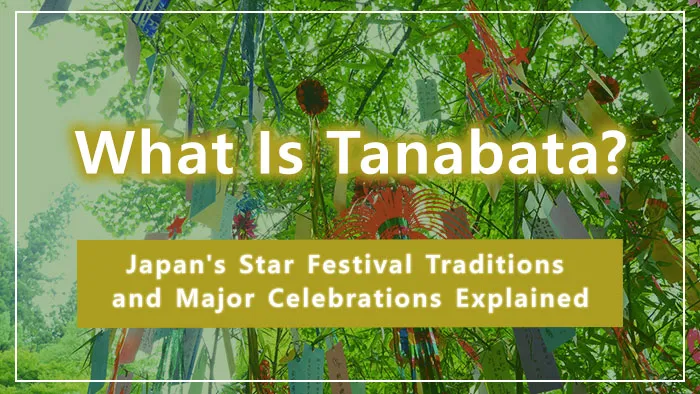
Tanabata is a beautiful Japanese seasonal celebration held every year on July 7th, when people entrust their wishes to the stars. The festival is rich with traditions passed down through the ages — from colorful tanzaku strips and bamboo decorations to the star-crossed legend at its heart.
Rooted in a tale from China and interwoven with Japan’s own folk beliefs, Tanabata has grown into a widely cherished event celebrated at schools, commercial venues, and local community gatherings. In some regions, the festival is observed in August in accordance with the traditional lunar calendar, adding a local flavor that varies from place to place — another part of what makes it so appealing.
In this article, we explore the origins and history of Tanabata, how to celebrate it at home, and some of the most prominent Tanabata festivals held across Japan. Whether you’re curious about Japanese seasonal culture or planning a trip to Japan, read on to discover everything you need to know.

1. What Is Tanabata? Japan’s Star Festival Explained

引用:unsplash.com
Tanabata (たなばた) is a traditional Japanese annual festival celebrated every year on July 7th. People write their wishes on tanzaku — small, narrow strips of colorful paper — along with other decorations, and hang them on bamboo branches as offerings to the stars.
Tanabata is also counted among Japan’s five classical seasonal celebrations known as gosekku (五節句). Today, it is widely observed at schools, shopping centers, and community events, and is fondly regarded as one of the signature sights of the summer season. In some regions, the festival takes place in August in line with the traditional lunar calendar, with vibrant festivities coinciding with the summer tourism season.
Tanabata is a celebration that embodies Japanese culture — expressing wishes upon the stars and gratitude toward the natural world.
1-1. Tanabata and the Legend of Orihime and Hikoboshi
At the heart of Tanabata lies a legend that originated in China: the story of Orihime and Hikoboshi.
Orihime was a diligent young weaver who worked beside the banks of the Milky Way (Amanogawa, or “River of Heaven”), while Hikoboshi was a devoted young man who tended cattle on the opposite shore. After the two married, they neglected their duties, and the Heavenly Emperor separated them to opposite banks of the Milky Way. However, on the condition that they each diligently fulfill their work, they were permitted to reunite just once a year, on the night of July 7th.
This tale is linked to two brilliant stars in the summer sky: Vega, the brightest star in the constellation Lyra, representing Orihime, and Altair, the brightest star in Aquila, representing Hikoboshi. On a clear night, both stars can be seen shining on either side of the Milky Way.
1-2. The History of Tanabata
Japan’s Tanabata tradition was formed through the merging of three distinct elements: an ancient Shinto ritual called Tanabata-tsume (棚機), in which a maiden would weave sacred cloth as an offering to the gods; a Chinese weaving festival called Kikkōden (乞巧奠, “Festival to Plead for Skills”), which was introduced to Japan during the Nara period (710–794); and the legend of Orihime and Hikoboshi.
Tanabata-tsume was a purification ritual in which a young woman wove cloth to offer to the gods, praying for a good harvest and good health. Kikkōden, meanwhile, was a ceremony in which people prayed for improved skill in weaving and other crafts, looking to the weaver star for guidance. It spread as a court event during the Heian period (794–1185) and became popular among ordinary people when it was designated one of the five gosekku seasonal festivals during the Edo period (1603–1868). The old custom of writing wishes on kaji (Japanese mulberry) leaves eventually evolved into the familiar practice of hanging colorful tanzaku strips on bamboo branches that we know today.
These layered histories have shaped the modern Tanabata tradition as it is celebrated now.
2. How to Celebrate Tanabata

引用:unsplash.com
Tanabata is a seasonal celebration that can be enjoyed casually at home, at school, or as part of a community event. People write wishes on tanzaku and hang them on bamboo branches, savor summer festival foods, and spend the evening gazing up at the night sky.
Across Japan, people observe Tanabata in ways that honor long-held customs while adapting them to contemporary life. Here is a look at how Tanabata is typically celebrated.
2-1. Hanging Wish-Written Tanzaku on Decorated Bamboo
One of the central customs of Tanabata is hanging tanzaku — wish-inscribed paper strips — and colorful decorations on bamboo branches. Bamboo, which grows straight and tall toward the sky, has long been regarded as a sacred plant in Japan and is seen as a symbol of carrying wishes up to the heavens.
Tanzaku traditionally come in five colors: blue, red, yellow, white, and black, rooted in the Chinese philosophy of the Five Elements (Wu Xing). The tradition originally began as a way to pray for improvement in skills such as weaving and calligraphy, but today people enjoy writing all sorts of wishes — from dreams for the future to hopes for the health of their families.
If bamboo is not available, houseplants or indoor decorations can serve as a substitute, so you can experience Tanabata culture even while traveling.
2-2. Eating Sōmen Noodles, the Traditional Festival Food
Sōmen — thin white wheat noodles — are the classic food associated with Tanabata. Their origins trace back to a Chinese wheat confection called sakubei (索餅), which was eaten during the Chinese equivalent of the festival and was introduced to Japan during the Nara period. Over time, the form and preparation evolved into what we now know as sōmen.
The long, slender white noodles are said to evoke the Milky Way and the threads woven by Orihime, making them a fitting food for the occasion. Cool and refreshing, sōmen is well suited to the summer table and offers an easy way to enjoy the spirit of Tanabata at home or while traveling.
2-3. Stargazing in Honor of Orihime and Hikoboshi
On the night of Tanabata, there is a tradition of gazing up at the stars while thinking of Orihime and Hikoboshi. Vega, the brightest star in Lyra, and Altair, the brightest star in Aquila, are known for shining on opposite sides of the Milky Way, and together with Deneb (the brightest star in Cygnus) they form the well-known Summer Triangle.
In places with clear skies, you can observe the faint, sweeping band of the Milky Way stretching between the two stars. In Japan, Tanabata is sometimes referred to as Hoshi Matsuri (Star Festival), and it is cherished as an opportunity to deepen one’s appreciation of nature and the cosmos.
3. Major Tanabata Festivals in Japan

引用:unsplash.com
Vibrant Tanabata festivals are held throughout Japan to coincide with the celebration. Through grand bamboo decorations that transform entire city streets, parades, and traditional events, visitors can experience the history and culture of each region.
Here is an introduction to some of the most prominent Tanabata festivals, known for their scale and highlights. Timing your visit to coincide with one of these events will allow you to enjoy Japan’s seasonal traditions all the more deeply.
3-1. Sendai Tanabata Festival | Miyagi Prefecture
The Sendai Tanabata Festival is one of the most iconic summer festivals in the Tohoku region, held annually from August 6th to 8th in Sendai City, Miyagi Prefecture. Said to trace its roots to the era of Date Masamune, the feudal lord of the Sendai Domain during the Edo period, it now draws large numbers of visitors from both Japan and abroad.
The shopping arcade streets are lined with spectacular Tanabata decorations crafted from washi (traditional Japanese paper) and bamboo, enveloping the entire city in a festive atmosphere. During the festival period, decoration contests, hands-on experience events, and digital stamp rallies are also held, making it a celebration where tradition and modern entertainment come together.
3-2. Shonan Hiratsuka Tanabata Festival | Kanagawa Prefecture
The Shonan Hiratsuka Tanabata Festival is a large-scale Tanabata event held in early July in the central shopping district of Hiratsuka City, Kanagawa Prefecture. It began as a postwar reconstruction initiative and has since grown into one of the most celebrated Tanabata festivals in the Kanto region.
More than 100 large, vividly colored Tanabata decorations line the shopping streets around Hiratsuka Station’s north exit, accompanied by food stalls and vendor booths. Community parades and stage events are also held throughout the festival, and the lively local energy is one of its greatest draws. Easy to reach from major urban centers, the event attracts large crowds of visitors each year.
3-3. Ichinomiya Tanabata Festival | Aichi Prefecture
The Ichinomiya Tanabata Festival is one of the leading Tanabata events in the Chubu region, held in Ichinomiya City, Aichi Prefecture. Rooted in the area’s history as a center of textile production, the festival began in 1956. The festival grounds are adorned with colorful Tanabata decorations, and a diverse program of events is on offer — including a procession and bon odori (traditional Bon Festival dancing) connected to the city’s textile heritage, as well as parades.
One of the most symbolic traditional events of the festival is the Gokoromo Hōken Daigyōretsu — a grand procession in which woven cloth is ceremonially offered. The warm, community-led atmosphere is another hallmark of the festival, and it is fondly regarded as a celebration that brings the spirit of Japanese summer culture within easy reach.
Conclusion
Tanabata is a traditional festival where a timeless, romantic legend — of wishes entrusted to the stars — intertwines with Japan’s deep sense of connection to nature and the seasons. The custom of decorating bamboo with tanzaku, the food culture of eating sōmen noodles, and the tradition of stargazing are all experiences that can be enjoyed in everyday life without much effort.
The Tanabata festivals held across Japan also offer a chance to discover the unique history and character of each region through stunning decorations and lively events. Timing your visit to Japan during the Tanabata season will give you a deeper appreciation of Japanese culture. We hope you get to experience the distinctly Japanese summer atmosphere firsthand, while sending your own wish up to the starlit sky.
*This article is based on information available as of March 2026.