









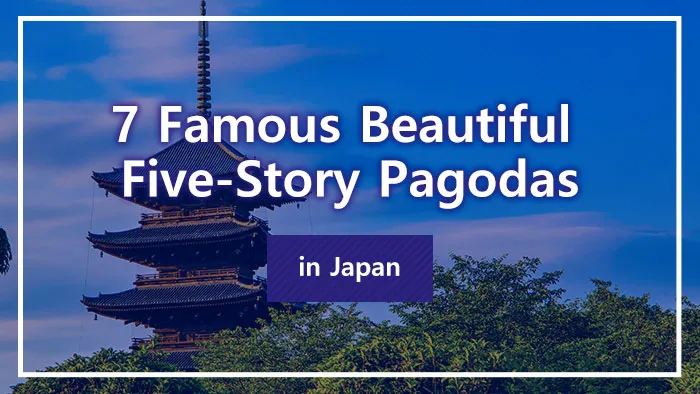
When traveling through Japan, you may encounter five-story pagodas that stand out prominently within temple precincts or cityscapes. However, not many people understand “why they were built” or “why they have five stories.” Passing by with only an appreciation for their visual beauty would be a somewhat missed opportunity.
This article explains the basic meaning and architectural structure of five-story pagodas before introducing beautiful representative pagodas from across Japan. By learning about the history and background surrounding five-story pagodas, a fleeting moment during sightseeing can transform into deeper learning and inspiration. If you wish to deepen your understanding of five-story pagodas and experience Japanese culture more richly, please use this as a reference.

- 1. What are Japanese Five-Story Pagodas?
- 2. 7 Beautiful Five-Story Pagodas in Japan
- 2-1. Toji Temple Five-Story Pagoda (Kyoto Prefecture)
- 2-2. Nikko Toshogu Shrine Five-Story Pagoda (Tochigi Prefecture)
- 2-3. Kofukuji Temple Five-Story Pagoda (Nara Prefecture)
- 2-4. Chureito Pagoda (Yamanashi Prefecture)
- 2-5. Rurikoji Temple Five-Story Pagoda (Yamaguchi Prefecture)
- 2-6. Shitennoji Temple Five-Story Pagoda (Osaka)
- 2-7. Itsukushima Shrine Five-Story Pagoda (Hiroshima Prefecture)
- Summary
1. What are Japanese Five-Story Pagodas?
弘法大師空海に託された国家鎮護の密教寺院「東寺(教王護国寺)」の誕生(823年)から今年は1200年。10月9日から31日まで京都市南区の東寺境内で、普段は入れない国宝五重塔の開扉や空海直筆の国宝「風信帖」の公開などの特別拝観「東寺のすべて」が行われます。→(続 pic.twitter.com/BdRPB5rdFr
— 美術展ナビ (@art_ex_japan) April 18, 2023
Five-story pagodas are Buddhist pagodas built at Buddhist temples, wooden structures constructed to enshrine Buddhist relics (sharira), the remains of Buddha. Their origin is the stupa of India, which was transmitted to Japan via China. Because Buddhism spread widely throughout Japan, many Buddhist pagodas were built across the country, with the wooden five-story pagoda being the representative form. The reason for five stories is based on the Buddhist philosophy of the Five Great Elements.
The Five Great Elements philosophy holds that the universe consists of five elements: earth, water, fire, wind, and void, with each roof of the five-story pagoda symbolizing these elements from bottom to top. Among multi-story pagodas, there are also three-story and seven-story pagodas, and the use of odd numbers reflects a philosophy that values auspiciousness. Many five-story pagodas of high historical value are designated as Important Cultural Properties.
1-1. Structure of Five-Story Pagodas
Five-story pagodas are Buddhist architectural structures built by stacking five independent layers from the bottom up. Each layer has a large roof with long eaves, and the width of the tower body gradually narrows toward the upper levels. Through the center of the pagoda runs a single pillar called the “shinbashira” (central pillar), which is separated from each layer and only touches at the top of the uppermost level.
At the tip of the central pillar, a metal “sorin” (finial) is attached. The sorin is a component derived from Indian stupas and is a symbolic element of Buddhist pagodas. Meanwhile, the wooden tower body originates from Chinese architectural styles.The interior is densely packed with wooden framework, leaving almost no space for people to move freely.
2. 7 Beautiful Five-Story Pagodas in Japan

引用:富士吉田市観光ガイド
Beautiful five-story pagodas deeply connected to history and faith remain throughout Japan. Here, we introduce particularly famous and impressive five-story pagodas from among the many that exist.
2-1. Toji Temple Five-Story Pagoda (Kyoto Prefecture)

Toji Temple’s five-story pagoda is a National Treasure pagoda boasting the tallest height among existing wooden pagodas in Japan. Known as a landmark of Kyoto, it reaches approximately 55 meters in height. Toji Temple was granted to Kukai by Emperor Saga in 823 and has served as the fundamental training hall for Shingon esoteric Buddhism; its official name is Kyoogokokuji Temple. After completing the lecture hall, Kukai embarked on the major construction project of the five-story pagoda, but faced shortages of funds and manpower.
Consequently, in 826, he submitted a document to the imperial court requesting cooperation in transporting timber, which remains on record. The five-story pagoda was destroyed four times by lightning strikes and other causes but was rebuilt each time, with the current pagoda being the fifth generation rebuilt in 1644. The interior of the first story contains Buddhist statues representing the world of esoteric Buddhism, and the walls and ceiling are decorated in brilliant colors.While normally closed to the public, it can be viewed during special opening periods in spring and autumn.
2-2. Nikko Toshogu Shrine Five-Story Pagoda (Tochigi Prefecture)
日光の東照宮、五重塔です。こちらの五重塔の免震機能は東京スカイツリーの心柱制振にも応用されて話題になりました。日本の美しい10秒動画はこちらです! https://t.co/TTNO74clAF pic.twitter.com/UjTeQX8gzq
— 和樂 公式 (@warakumagazine) January 13, 2016
Nikko Toshogu Shrine’s five-story pagoda is a pagoda designated as an Important Cultural Property, known for its excellent earthquake-resistant structure. Standing within the precincts of Nikko Toshogu Shrine in Nikko City, Tochigi Prefecture, a central pillar is positioned at the tower’s center. This structure has received high praise and is said to have been applied to the design of Tokyo Skytree. The original pagoda was built in 1650 through the donation of Sakai Tadakatsu, but was destroyed by lightning in 1815, with the current pagoda being the second generation rebuilt in 1818.
Its exterior decorated in brilliant colors is also characteristic, with carvings of the twelve zodiac animals arranged on the curved beams of the first story. A tiger is placed on the front because Tokugawa Ieyasu was born in the Year of the Tiger.Normally only the exterior can be viewed, but during special openings, visitors can tour the interior and see all twelve zodiac animals.
2-3. Kofukuji Temple Five-Story Pagoda (Nara Prefecture)

引用:奈良県
Kofukuji Temple’s five-story pagoda is the second tallest five-story pagoda in Japan, symbolizing the ancient capital of Nara. Five-story pagodas are tomb markers that enshrine Buddha’s relics and hold great significance as symbols protecting Buddhist teachings at Buddhist temples. The five-story pagoda of Kofukuji Temple, standing in the center of Nara, was built in 730 through the vow of Empress Komyo, daughter of the temple’s founder Fujiwara no Fuhito.
Thereafter, it repeatedly burned down and was rebuilt due to numerous fires, with the current pagoda being rebuilt around 1426. With a height of approximately 50.9 meters, it is also the tallest structure in Nara Prefecture. A major attraction is that while maintaining its original location from the time of foundation, it combines both the architectural style of the Nara period and the powerful expression of the medieval period.
2-4. Chureito Pagoda (Yamanashi Prefecture)

引用:富士吉田市観光ガイド
Chureito Pagoda is a memorial tower built to commemorate those who died in war and honor their achievements.Located on the mid-slope of Mount Arakura in Fujiyoshida City, Yamanashi Prefecture, its official name is Fujiyoshida City War Memorial Tower. It enshrines 1,055 spirits of city natives who died in battles from the Sino-Japanese War through the Pacific War.
The pagoda, completed in 1962, was modeled after the five-story pagoda of Shitennoji Temple in Osaka and was built through the donations and dedication of citizens under difficult circumstances. Currently beloved as a symbol of Arakurayama Sengen Park, it has become a tourist destination highly praised both domestically and internationally for its spectacular views of cherry blossoms in spring with Mount Fuji in the background.
2-5. Rurikoji Temple Five-Story Pagoda (Yamaguchi Prefecture)

引用:山口県観光サイト
Rurikoji Temple’s five-story pagoda is a National Treasure five-story pagoda representing the Muromachi period, counted as one of Japan’s Three Famous Pagodas.Standing in Kozan Park in Yamaguchi City, its origins date back to the latter half of the 14th century. During the time of the 25th head of the Ouchi clan, Ouchi Yoshihiro, Kozekiji Temple was built, and construction of the five-story pagoda proceeded to mourn his elder brother.
The pagoda was completed around 1442 and, after the temple’s relocation, became the current Rurikoji Temple five-story pagoda. It is the 10th oldest among existing five-story pagodas, and its elegant form conveys the prosperity of Ouchi culture to the present day. Its cypress bark roof and well-proportioned tower body are characteristic features, with nighttime illumination also being a highlight.
2-6. Shitennoji Temple Five-Story Pagoda (Osaka)
四天王寺・五重塔の改修工事が完了 聖徳太子の千四百年御聖忌に向け https://t.co/1KWNiIjXqe pic.twitter.com/vUc2fRBrds
— あべの経済新聞 (@abenokeizai) July 19, 2016
Shitennoji Temple’s five-story pagoda is a five-story pagoda built in the central temple complex of Shitennoji Temple, Japan’s oldest government temple, reproducing the Asuka period style. Shitennoji Temple is a temple built by Prince Shotoku in 593 to enshrine the Four Heavenly Kings, conveying the beginning of Japanese Buddhism to the present day.
The current five-story pagoda was rebuilt in 1959 with steel-reinforced concrete construction. While the exterior references the five-story pagoda of Horyuji Temple, the interior features a six-layer structure with a spiral staircase. A distinctive feature is the restoration of the ancient temple’s appearance based on excavation research results, representing a modern five-story pagoda that balances earthquake resistance with historical design.
2-7. Itsukushima Shrine Five-Story Pagoda (Hiroshima Prefecture)

引用:一般社団法人宮島観光協会
Itsukushima Shrine’s five-story pagoda is a historically valuable five-story pagoda with beautiful vermilion lacquer, standing on “Tower Hill” on the east side of Itsukushima Shrine.
Founded in 1407, it is known as a cypress bark-roofed pagoda characterized by an architectural style that fuses Japanese and Zen styles. The structure where the central pillar stops at the second story is unusual, and the interior preserves wall paintings depicting cloud dragons, lotus ponds, the Hundred-Robe Kannon, and the Eight Patriarchs of Shingon Buddhism, vividly conveying a religious worldview.
Near the five-story pagoda stands Senjokaku, a hall whose construction was advanced by Ankokuji Ekei under orders from Toyotomi Hideyoshi, but which remained unfinished due to Hideyoshi’s sudden death. With space to lay 857 tatami mats and features such as gold leaf-decorated roof tiles, it is thought that if completed, it would have been a magnificent building reflecting Momoyama culture.
Summary
Five-story pagodas remaining throughout Japan are traditional architectural structures condensing Buddhist philosophy, Japanese history, and aesthetic sensibility. While each has different historical backgrounds and roles, they have been carefully passed down as cultural heritage. The five-story form embodies Buddhist cosmology, and from their structure and decoration, one can discern sophisticated architectural techniques and religious devotion.
When sightseeing, please look not only at their external beauty but also at the purpose of their construction and historical background. By visiting with an understanding of the meaning of five-story pagodas, your view of temples, shrines, and townscapes will change, deepening your understanding of Japanese culture.
*This article is based on information as of December 2025