







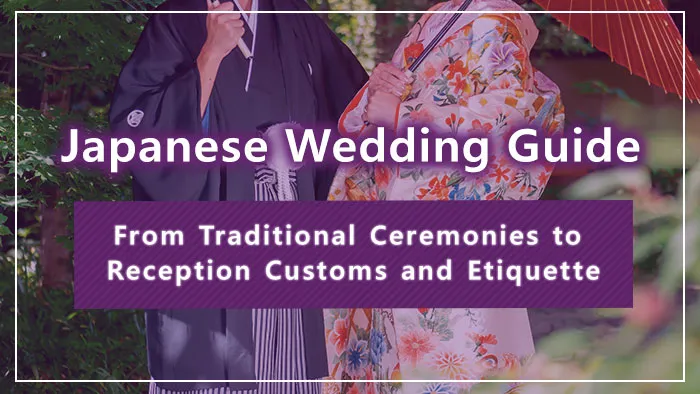
Japanese weddings are not merely ceremonial events, but important cultural occasions that give tangible form to religious beliefs, family values, and feelings of gratitude. While an increasing number of couples choose church-style ceremonies in recent years, Japan has long inherited wedding formats deeply connected to Shinto and Buddhism. Additionally, receptions feature distinctively Japanese performances with special meanings, such as Kagami-biraki, Oironaoshi, and letter readings.
This article organizes and clearly explains the types of traditional Japanese weddings, representative reception performances, and taboos to be mindful of at weddings, all within the context of Japanese culture.

1. The Four Types of Japanese Wedding Ceremony
In modern Japan, many people choose church-style (Christian-inspired) weddings held at hotels or wedding venues. While these ceremonies proceed in Christian format with hymns and ring exchanges, the bride and groom and their parents are not necessarily Christians. In fact, most Japanese are considered Buddhists or non-religious.
On the other hand, some people still hold traditional weddings, valuing Japanese culture and family values. Japan has weddings deeply tied to religion, such as the Shinto Shinzen-shiki and the Buddhist Butsuzen-shiki. Here, we introduce the characteristics and meanings of each type of wedding in an accessible way.
Japanese wedding ceremonies fall into four main types. The table below sums up the differences before we go through each one.
| Type | Venue | Officiant / witnesses | Features |
|---|---|---|---|
| Shinzen-shiki (Shinto) | A shrine, or a shrine room inside a venue | Shinto priest and miko | The bride wears shiromuku or iro-uchikake. The san-san-kudo sake exchange, with emphasis on joining two families |
| Kyokai-shiki (Christian-style) | A church, or a chapel inside a hotel or wedding venue | Pastor or priest | The most common style in Japan today. The bride wears a white dress; hymns and a ring exchange |
| Jinzen-shiki (guest-witnessed) | Anywhere the couple chooses | The guests themselves | No religious framework. Vows, order of events and attire are all up to the couple. Increasingly popular |
| Butsuzen-shiki (Buddhist) | A temple, or before the family Buddhist altar | Buddhist monk | Sutra chanting and incense; vows extend into the next life. Very rarely held today |
1-1. Shinzen-shiki (Shinto)
Shinzen-shiki is a traditional Japanese wedding ceremony held at a shrine or chapel. Based on Shinto beliefs, couples report their marriage before the deities and pledge to begin their journey together as husband and wife.
The central ritual of the ceremony is “san-san-kudo no gi (sankon no gi),” where the bride and groom exchange cups and share sacred sake. This act symbolizes the unity of hearts as a married couple and deepens family bonds. Furthermore, during tamagushi-hairei, they offer gratitude to those who have supported them throughout their lives and for the fate that brought them together.
A distinctive feature of Shinzen-shiki is that it values not only the couple’s vows but also the bonds between the two families. After marriage, couples can continue visiting the same shrine for hatsumode (New Year’s shrine visit) and children’s milestone celebrations, making it a wedding ceremony deeply connected to life’s turning points.
1-2. Butsuzen-shiki (Buddhism)
Butsuzen-shiki is a wedding ceremony conducted based on Buddhist teachings, held at a temple or before a home Buddhist altar. In Buddhism, the couple’s marriage is believed to result from “karma” from past lives. In Butsuzen-shiki, the couple reports their marriage to Buddha and ancestors, expressing gratitude. A major characteristic is pledging a bond that continues not only in this life but also in the next.
Unlike the vows spoken in Shinzen-shiki or church weddings, the couple quietly demonstrates their commitment through sutra chanting and incense burning performed by monks. Additionally, a ritual called “nenju juyo” may be performed, where monks bestow prayer beads upon the couple.
Butsuzen-shiki is a wedding ceremony where one can reaffirm respect for ancestors, and its appeal lies in experiencing the gravity of marriage in a solemn and calm atmosphere.
1-3. Kyokai-shiki (Christian-Style)
Kyokai-shiki is the most commonly chosen wedding style in Japan today. It is held in a church, or in a chapel attached to a hotel or wedding venue, and is led by a pastor or priest.
The ceremony typically includes the processional, hymns, a Bible reading, the vows, the ring exchange, and the signing of the marriage certificate. The bride in a white dress, walking down the aisle with her father, is the image most Japanese people picture when they think of a wedding.
As noted above, the couple are not necessarily Christian. Most venues offer it as a ceremony style and do not require any particular faith.
1-4. Jinzen-shiki (Guest-Witnessed)
Jinzen-shiki follows no particular religion. The couple make their vows to the guests, who serve as the witnesses to the marriage.
Its defining quality is freedom. It is not tied to a shrine or a church, and the wording of the vows, the order of events and the staging are all decided by the couple. Some couples have their guests sign the marriage certificate together, or ask the whole room to raise their hands in approval.
There are no rules on attire either, so either kimono or a white dress works. The number of couples choosing jinzen-shiki has been rising in recent years.
2. Traditional Events at Japanese Wedding Receptions
Japanese wedding receptions feature not only dining and conversation but also traditional performances based on long history and culture. These events serve to celebrate the bride and groom’s new beginning and express gratitude to family and guests.
Here, we introduce representative traditional events commonly held at receptions, along with their meanings and backgrounds.
2-1. Kagami-biraki
Kagami-biraki is an auspicious Japanese performance held at the beginning of the reception or before the toast. It is a ritual where the lid of a sake barrel is opened with a wooden mallet. “Kagami” refers to the circular lid, and the expression “biraki (opening)” is used rather than “waru (breaking).” This is because it symbolizes opening up the future and inviting good fortune. The round shape of the sake barrel lid also symbolizes marital harmony and family unity.
Kagami-biraki is believed to have originated during the Muromachi period (around the 14th century) and is deeply connected to sake culture. After the ritual, it is common to pour sake from the barrel into masu (wooden boxes) and serve it to guests.It can be described as a vibrant and memorable performance that allows the entire venue to share in the celebration.
2-2. Oironaoshi
Oironaoshi is a performance where the bride and groom change outfits during the reception. Currently, changing into Western attire is common, but its origins lie in traditional Japanese wedding culture. Originally, when the bride changed from shiromuku (white kimono) to iro-uchikake (colored kimono), it represented “being dyed in the colors of the new family.”
It often takes place in the middle of the reception, and since the bride and groom temporarily leave, it also serves as a break for guests. The costume change refreshes the venue’s atmosphere, and the couple receives significant attention when they re-enter. Recently, more couples limit Oironaoshi to once, prioritizing time with guests, but it remains one of the important performances that adds glamour to the reception.
2-3. Letter Reading
A letter reading from the bride and groom to their parents often takes place near the end of the reception. In particular, the bride’s letter to her parents is known as a touching scene that symbolizes Japanese weddings. This custom became widespread in the 1990s, expressing gratitude to parents for raising them, memories from the past, and determination for the future.
It is a valuable opportunity to convey feelings that are usually too embarrassing to express in a formal setting. It can be said to be a performance that reflects the “heart that values gratitude” deeply rooted in Japanese culture.
2-4. Gift Presentation
Gift presentation is a performance at the end of the reception where the bride and groom tangibly express their gratitude to parents and guests. For parents, it is common to give practical items or memorable gifts as thanks for raising them.
Additionally, gifts called “hikidemono” are prepared for guests. These represent gratitude for their attendance and the desire to continue valuing good relationships in the future.
Furthermore, there is a custom of later sending gifts called “uchiiwai” to those who could not attend the wedding. Such gift-giving culture reflects uniquely Japanese values of considering others and demonstrating gratitude through actions.
3. Taboos at Japanese Weddings
At Japanese weddings, “behavior appropriate for a celebratory occasion” is valued. Therefore, there are unique taboos that may be difficult for foreigners to understand, such as word choice and monetary etiquette. By knowing basic taboos in advance, you can avoid being rude and participate in the ceremony with confidence.
Here, we introduce two particularly important points.
3-1. Avoiding Inappropriate Words
At Japanese weddings, the use of words called “imikotoba” (words of ill omen), which are considered inauspicious, is avoided.
First, words that evoke separation should be avoided. Words like “separate,” “part,” “end,” and “cut” are inappropriate for a wedding, which marks a new beginning. Next, caution is needed with “kasane-kotoba” (repeated words), which use the same word twice. Expressions like “repeatedly” and “often” may be avoided as they can suggest remarriage. However, words like “day by day” and “increasingly” may be acceptable when used in a positive sense.
Furthermore, negative words such as “painful,” “difficult,” and “dislike” are inappropriate as they darken people’s spirits. At weddings, it is important to be considerate by crafting expressions and rephrasing them into positive and warm language whenever possible.
3-2. Using Odd-Number Amounts for Goshugi
At Japanese weddings, it is common etiquette to make Goshugi (monetary gifts) in odd-number amounts. Originally, this derives from Chinese Yin-Yang Five Elements philosophy, where odd numbers are considered auspicious as “yang numbers.”
However, in modern Japan, the popular belief that “even numbers are divisible and thus unlucky as they suggest separation” is more widely known than this philosophy. Therefore, odd numbers such as 30,000 yen or 50,000 yen are often chosen.
There are exceptions, however, as “8” is favored even as an even number because it represents “suehirogari” (expanding prosperity) and is considered auspicious. Conversely, “9” tends to be avoided even as an odd number because its pronunciation evokes “ku” (suffering). It is important to remember that Goshugi amounts should be decided according to one’s relationship with and position relative to the bride and groom, and are not necessarily uniform.
Conclusion
Traditional Japanese weddings, as represented by Shinzen-shiki and Butsuzen-shiki, are fundamentally rooted in a culture that values religious beliefs and family connections. Even at receptions, each element—whether Kagami-biraki, Oironaoshi, or letters to parents—carries meanings of gratitude and celebration of new beginnings. Taboos and manners, such as avoiding imikotoba and choosing odd numbers for Goshugi, reflect Japanese consciousness of cherishing celebratory occasions.
Understanding this background reveals that Japanese weddings are not merely formal events but occasions to confirm human connections and thoughtfulness. Learning the meanings behind traditions is the first step toward deepening one’s understanding of weddings.
*This article is based on information available as of August 2026.