







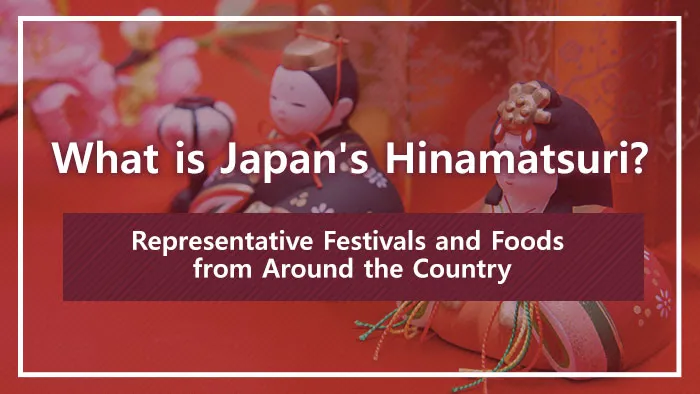
Hinamatsuri is a traditional event held annually in Japan on March 3rd, passed down as a day to wish for the healthy growth and happiness of girls. The sight of hina ningyō (hina dolls) on display, surrounded by hina-arare and chirashi-zushi, is a seasonal tradition that evokes the arrival of spring for many households.
Hinamatsuri is not merely a children’s event, but a historic occasion formed through the layering of ancient Chinese sekku (seasonal festival) culture and uniquely Japanese beliefs.
This article explains not only the meaning and history of Hinamatsuri, but also representative Hinamatsuri events held throughout Japan and the wishes embedded in the festival foods.

- 1. What is Hinamatsuri?
- 2. The History of Hinamatsuri
- 3. Famous Hinamatsuri Festivals in Japan
- 3-1. Katsuura Big Hinamatsuri (Katsuura City, Chiba Prefecture)
- 3-2. Konosu Bikkuri Hinamatsuri (Konosu City, Saitama Prefecture)
- 3-3. Yanagawa Hinamatsuri Sagemon Meguri (Yanagawa City, Fukuoka Prefecture)
- 3-4. Kasuisai Hinamatsuri (Fukuroi City, Shizuoka Prefecture)
- 3-5. Makabe no Hinamatsuri (Makabe Town, Sakuragawa City, Ibaraki Prefecture)
- 4. Hinamatsuri Foods
- Conclusion
1. What is Hinamatsuri?
3月3日桃の節句(ひな祭り)に合わせて、ひな人形の展示を行っています🌸🎎ちなみにパラオ語では「オニンギオ(oningio)」という単語が日本語の「人形」と同じ意味で使われています😆 pic.twitter.com/z72bsTNZgI
— 在パラオ日本国大使館(Embassy of Japan in Palau) (@OfPalau) February 26, 2024
Hinamatsuri is a traditional Japanese event held annually on March 3rd, a day to wish for the happiness and healthy growth of girls. Since March 3rd in the old lunar calendar corresponds to the time when peach blossoms bloom, it is also called “Momo no Sekku” (Peach Festival). When Hinamatsuri season arrives, many households display hina ningyō and celebrate by preparing festival foods such as hina-arare and chirashi-zushi.
Hina ningyō are dolls dressed in Heian-period aristocratic costumes, typically arranged on tiered platforms covered with red cloth. The dolls embody the meaning of “transferring misfortune to the dolls and having them serve as substitutes.” Therefore, while Hinamatsuri is a glamorous event, it is also an important opportunity for families to express their feelings while thinking about their children’s health and future.
Today, it is enjoyed not only in homes but also as community events, beloved as a seasonal celebration where Japanese culture can be experienced.
2. The History of Hinamatsuri

The origins of Hinamatsuri trace back to “Jōshi no Sekku” (Shangsi Festival) held during the mid-Heian period. People of that time entrusted their misfortunes to dolls made of paper and floated them down rivers or into the sea, praying for good health and protection from illness. Around the same time, “hina asobi” (doll play) using dolls spread among aristocratic girls.
During the Muromachi period, Jōshi no Sekku became fixed on March 3rd, and when the Edo period began, it spread to commoners through imperial court events and the shogunate’s Ōoku (inner palace). The custom of celebrating a girl’s first sekku (hatsu-zekku) emerged, and hina ningyō evolved from a single pair of dairi-bina (emperor and empress dolls) to tiered displays. During the Meiji era, the practice temporarily declined but revived as an event rooted in daily life, and today it is cherished in homes and community events. In modern times, diverse ways of celebration have become established to suit living environments and lifestyles.
3. Famous Hinamatsuri Festivals in Japan
Throughout Japan, when Hinamatsuri season arrives, large-scale events are held that utilize the unique characteristics of each region. While Hinamatsuri has a strong image as an event celebrated at home, there are also many events where entire communities display hina ningyō and welcome tourists. The scenery where historic townscapes or shrines and temples harmonize with hina ningyō offers a valuable opportunity to experience Japanese culture firsthand.
Here we introduce representative Hinamatsuri festivals in Japan that are especially popular with international tourists.
3-1. Katsuura Big Hinamatsuri (Katsuura City, Chiba Prefecture)
Katsuura Big Hinamatsuri is a community-wide Hinamatsuri held annually in Katsuura City, Chiba Prefecture from late February through March 3rd. For 2026, it has been decided that the event will be held from Saturday, February 21st through Tuesday, March 3rd.
The main highlight is the spectacular kaidan-bina (staircase dolls) arranged on approximately 60 stone steps at Tomisaki Shrine, where residents carefully display the dolls from morning on clear days. About 10,000 hina ningyō are displayed throughout the city, and in 2024, approximately 160,000 people attended. Evening illumination and limited-edition goshuin (temple stamps) are also popular, making this an event where you can experience Japanese culture and the spirit of omotenashi (hospitality).
3-2. Konosu Bikkuri Hinamatsuri (Konosu City, Saitama Prefecture)
Konosu Bikkuri Hinamatsuri is a festival held in Konosu City, Saitama Prefecture, known as “the hometown of hina dolls.” Konosu is a region with approximately 400 years of doll-making history, and the event is held to promote its appeal.
The main feature is Japan’s tallest piramiddo hinadana (pyramid hina display), standing approximately 7 meters high with 31 tiers. This overwhelmingly large-scale hina display is famous nationwide and attracts many tourists. The appeal lies in the ability to enjoy Hinamatsuri throughout the entire town while cherishing the original meaning of Jōshi no Sekku—wishing for good health and protection from illness.
3-3. Yanagawa Hinamatsuri Sagemon Meguri (Yanagawa City, Fukuoka Prefecture)
Yanagawa Hinamatsuri Sagemon Meguri is a spring tradition held annually in Yanagawa City, Fukuoka Prefecture from mid-February through early April. For 2026, it will be held from Wednesday, February 11th (national holiday) through Friday, April 3rd.
In the Yanagawa region, there is a custom of displaying colorful hanging decorations called “sagemon” alongside hina platforms for a girl’s first sekku. The auspicious fabric crafts featuring cranes, rabbits, and other motifs embody the family’s wishes. During the event period, water parades and nagashi-bina (floating dolls) are also held, allowing visitors to simultaneously enjoy the unique landscape of the water town Yanagawa and Japanese sekku culture.
3-4. Kasuisai Hinamatsuri (Fukuroi City, Shizuoka Prefecture)
At Akiha Sōhonden Kasuisai temple in Fukuroi City, Shizuoka Prefecture, “Kasuisai Hinamatsuri” is held annually. For 2026, it will be held from January 1st through March 31st, featuring a spectacular 32-tier display with approximately 1,200 dolls, considered one of Japan’s largest.
Many of the displayed hina ningyō were donated for memorial services. By displaying dolls that have completed their roles, the event conveys the spirit of cherishing objects and the transmission of traditional culture.With shōjin ryōri (Buddhist vegetarian cuisine) and interactive exhibits, this is a popular event for families and international tourists alike.
3-5. Makabe no Hinamatsuri (Makabe Town, Sakuragawa City, Ibaraki Prefecture)
Makabe no Hinamatsuri is a town-walking style Hinamatsuri held annually in Makabe Town, Sakuragawa City, Ibaraki Prefecture from early February through March 3rd. Hina ningyō are displayed in historic merchant houses, private homes, sake breweries, inns, and other locations, allowing visitors to enjoy the exhibits while touring the entire town. Another feature is the ability to view hina ningyō from different eras—Taishō, Shōwa, and Heisei—all at once.
The scenery where Makabe Town’s traditional architecture harmonizes with hina displays is cherished by many tourists as a precious experience where Japanese daily life and sekku culture can be felt intimately.
4. Hinamatsuri Foods
高岡商店街を会場に、ひな祭りを楽しむ「おきゃく」が開催!
— 高知県 (@pref_kochi) February 28, 2019
文旦ひな人形の展示のほか、グルメの出店や日本酒の呑み比べなど、催し物がもりだくさん♪
日時:3月3日(日)10:00~16:00
会場:土佐市高岡商店街
問:088-881-3359 pic.twitter.com/cgJOISfFMs
During Hinamatsuri, visually gorgeous foods with auspicious meanings are served at the table. These dishes and sweets embody wishes for the healthy growth and happiness of girls. By knowing not only the taste but also the meaning embedded in each food, you can understand Hinamatsuri more deeply.
Here we introduce representative foods essential to Hinamatsuri.
4-1. Hina-arare

Hina-arare is a colorful confection that symbolizes Hinamatsuri. Three colors are often used—pink, white, and green—each with its own meaning. Pink represents warding off evil, white represents purity, and green represents health. There is a theory that it was originally made by crushing hishimochi, and it embodies wishes for children’s growth.
In Kantō, they are rice grain-shaped with a sweet taste, while in Kansai, they are round with salt or soy sauce flavors—regional differences that can also be enjoyed.
4-2. Chirashi-zushi
3/3はひな祭り🎎
— 市川市 (@ichikawa_shi) March 3, 2023
女の子の健やかな成長を願う桃の節句の行事です✨
ちらし寿司はお祝いごとで食べられており、エビやレンコンなどの食材が使われます。
エビは腰が曲がるまで長生きする、レンコンは先の見通しが良くなるという願いが込められた縁起物です!
華やかなちらし寿司で楽しく祝いましょう♪ pic.twitter.com/8KMHCO3NgC
Chirashi-zushi is widely beloved as a standard Hinamatsuri dish. In Japan, there is a custom of eating sushi on celebratory occasions, and colorfully vibrant chirashi-zushi is particularly suitable for sekku celebrations. The ingredients include shrimp for longevity, lotus root representing clear foresight, and kinshi tamago (shredded egg crepe) evoking gold and silver treasures, all with auspicious meanings. It’s a dish where both visual beauty and meaning can be enjoyed.
4-3. Hishimochi

引用:@AmbJaponFR
Hishimochi is a representative Hinamatsuri wagashi (Japanese confection) made by stacking pink, white, and green mochi in a diamond shape. Pink is said to mean warding off evil, white represents fertility and purity, and green signifies health.
The diamond shape represents the seed of the hishi (water caltrop) plant, embodying wishes for strong vitality and longevity. While the color combinations have changed over time, the current three colors became established after the Edo period.
4-4. Sakuramochi
大島桜の桜餅🌸
— シャトレーゼ【公式】 (@chateraise_jp) February 13, 2023
粒が残ったもちもち生地と、あっさり上品なこし餡。伊豆産の大島桜葉と塩味がおいしさを引き立てます。
春の訪れを感じられる和菓子をどうぞ😊
byりこ#シャトレーゼ #桜餅 pic.twitter.com/uoICJKBbVh
Sakuramochi is beloved as a wagashi whose spring-like colors suit Hinamatsuri. While there is no clear origin, it is thought to have become standard due to its gorgeous appearance befitting Momo no Sekku.
In Kantō, the “Chōmeiji” style wraps bean paste in wheat flour dough, while in Kansai, the “Dōmyōji” style wraps it in mochi rice dough. The appeal lies in being able to taste regional differences.
4-5. Hamaguri no Osuimono (Clam Clear Soup)
Hamaguri no Osuimono is an essential soup dish for Hinamatsuri. Since clam shells only fit perfectly with their matching pair, they are considered symbols of good matches and marital harmony. Therefore, they embody the wish that girls will be blessed with good relationships in the future. The elegantly flavored clear soup enhances celebratory occasions.
4-6. Amazake
ひな祭りに飲む白酒とはどんなもの? 中国酒や甘酒との違いも解説https://t.co/NN78HbfMv9 pic.twitter.com/5ZTBfzJ8AO
— 小学館 Oggi (@oggi_jp) December 31, 2024
Amazake (sweet rice wine) is often consumed during Hinamatsuri. Originally, “tōka-shu” (peach blossom wine), made by soaking peach blossoms in sake, was consumed, but after the Edo period, shirozake (white sake) became widespread. However, since shirozake contains alcohol, nowadays amazake without alcohol is prepared for children.
Amazake carries meanings of warding off evil and wishing for longevity, gently coloring Hinamatsuri celebrations.
Conclusion
While Hinamatsuri is known as an event celebrating girls’ growth, the Japanese values of dispelling misfortune and wishing for family happiness are alive in its background. Originating from Jōshi no Sekku and doll beliefs, the ways of displaying hina ningyō and celebrating have changed over time, but the feelings toward children remain unchanged. Additionally, festival foods such as hina-arare, hishimochi, and hamaguri no osuimono each embody meanings wishing for healthy growth and good relationships.
By welcoming Hinamatsuri with an understanding of its origins and meanings, each meal and decoration can be felt as something more special. When experiencing Hinamatsuri in Japan, please enjoy it while reflecting on its background.
*This article is based on information available as of January 2026.